If you have been reading Irish retrofit coverage over the past five years, you could be forgiven for thinking “heat pump” means one specific thing: air-to-water hydronic, feeding radiators or underfloor. We went a different direction. Ten units across our site, all air-to-air — the kind that looks like an air-conditioning unit on the wall, because that is exactly what it also does.
Why air-to-air, not air-to-water
The question most people don't ask is why air-to-water in the first place. The default Irish retrofit assumption is: tear out the oil boiler, put in a heat pump that feeds the same radiators you already have. In practice, this works well in only one of its two common configurations.
Air-to-water into underfloor heating is a genuinely good match. Underfloor runs at low flow temperatures (35–45°C), the thermal difference between the water and the room air is small, and that is exactly where a heat pump is at its most efficient. High COP, happy hardware. Air-to-water into traditional radiators is a different story. Rads work by heating air through convection, and they need the water running through them to be meaningfully hotter than the room — around 60–70°C for conventional radiators, 45–55°C for the newer “low-temperature” radiators sold for heat pump retrofits. A heat pump can deliver 45°C comfortably but struggles above that, and the COP drops sharply as the flow temperature climbs. Either the radiators have to be dramatically oversized to run cool, or the heat pump has to run hotter than it wants to — and the COP falls accordingly.
There is a bigger structural question underneath that detail. Air-to-water into radiators is heating air circuitously: outside air → heat pump → water → hydronic circuit → radiator → inside air. Four heat transfers, each with its own losses. Air-to-air takes heat from outside air and puts it directly into inside air. One transfer. No water, no pump, no radiator. A lot of Irish retrofits that kept their original radiators have quietly discovered the compounded cost of all those extra steps.
Neither of those routes worked for us. Our buildings are restored mid-1800s farm structures of the former Smith Barry Estate — stone-walled, high-ceilinged, built for a different purpose. The question for us wasn't “how do we replace the oil boiler.” It was “how do we make these spaces comfortable to work in, year round, without burning anything on site?”
When I put that question to Richard English of Recool Limited, his answer surprised me. He asked why I was assuming air-to-water. With air-to-air, he said, you solve two problems with one system: heat in winter, cooling in summer. Air-to-water handles the heating half and leaves the cooling half unsolved. If what you need is comfort across both halves of the year, air-to-air does it with one install.
That was the moment the specification question clarified. The right system depends on what problem you are actually solving.
For a well-insulated home with hydronic radiators or underfloor, and nobody complaining about summer, air-to-water remains the right answer. For spaces that are hot in July and cold in January — and for a site that was going to need to install cooling eventually anyway — air-to-air does both jobs with one piece of hardware.
The training room — the first install
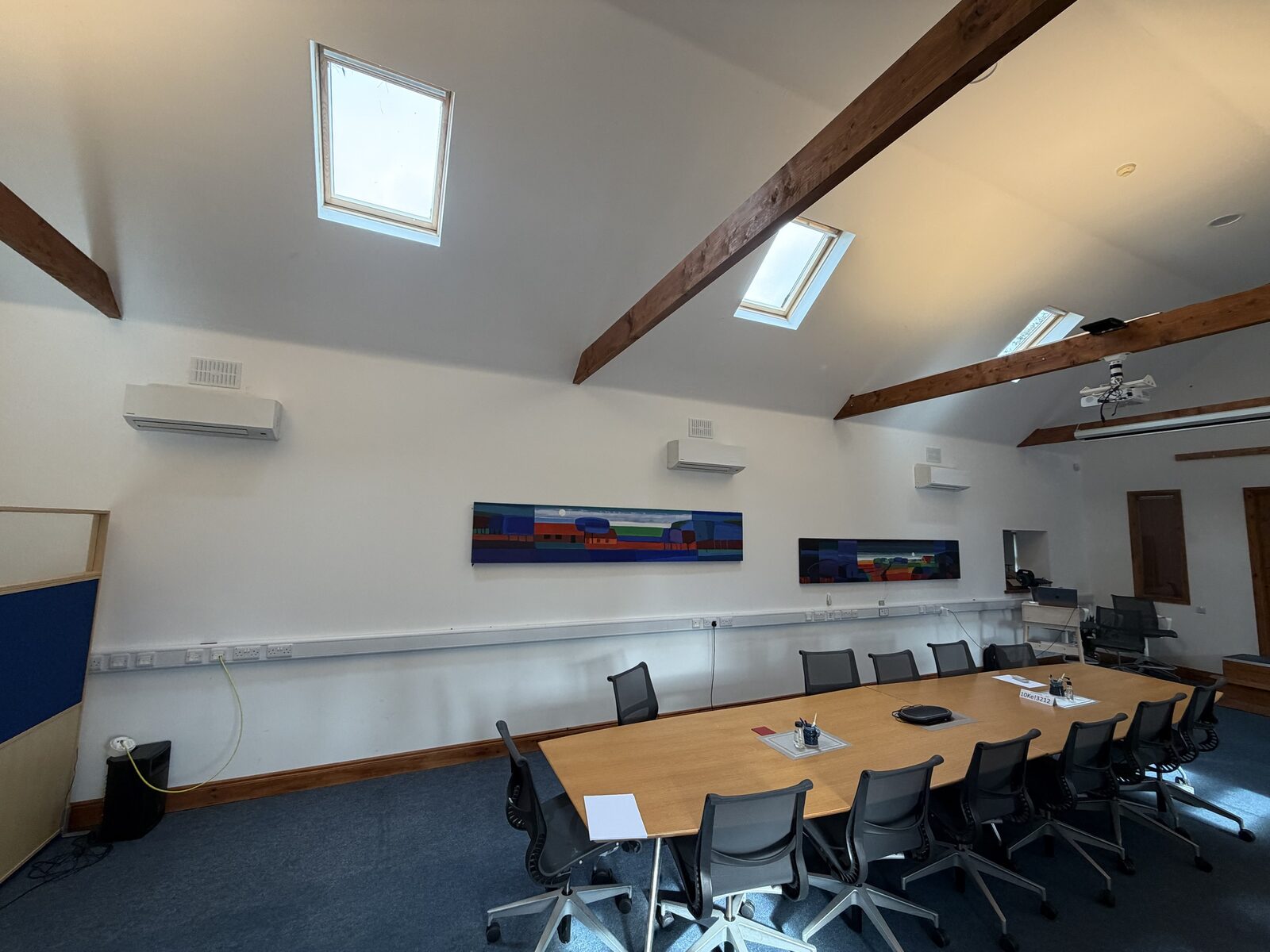
The decision wasn't abstract. We had a specific room with a specific problem.
The training room is a large space with a very high V-shaped ceiling. When our call centre was still office-based, it housed a chunk of our team. The architecture made it almost impossible to heat properly: all the warm air rose into the apex of the V and sat there, and the staff below worked in whatever draught was left behind. Radiators ran at full blast all winter and people were still cold. Honest complaints — the room was uncomfortable and no amount of radiator output seemed to fix it.
The flip side was the summer. We ran a two-day training round-table during one particularly hot summer. Portable air-conditioning units came in. Even with them running flat out, the room averaged 26 to 28 degrees. That is not a working temperature.
A space that was impossible to heat in winter and impossible to cool in summer with the tools we had: that was the specific case the air-to-air decision was being made against.
Three units went up along the north-facing wall. The result was transformative in both directions. In winter the room is comfortable within twenty minutes of turning the units on. In summer the same hardware delivers comfort at thirty-plus degrees outside. The round-table sessions that previously were an endurance test are now a non-issue.
One room, one install, two problems solved. The specification question was answered on the first day the units ran.
How these units actually work
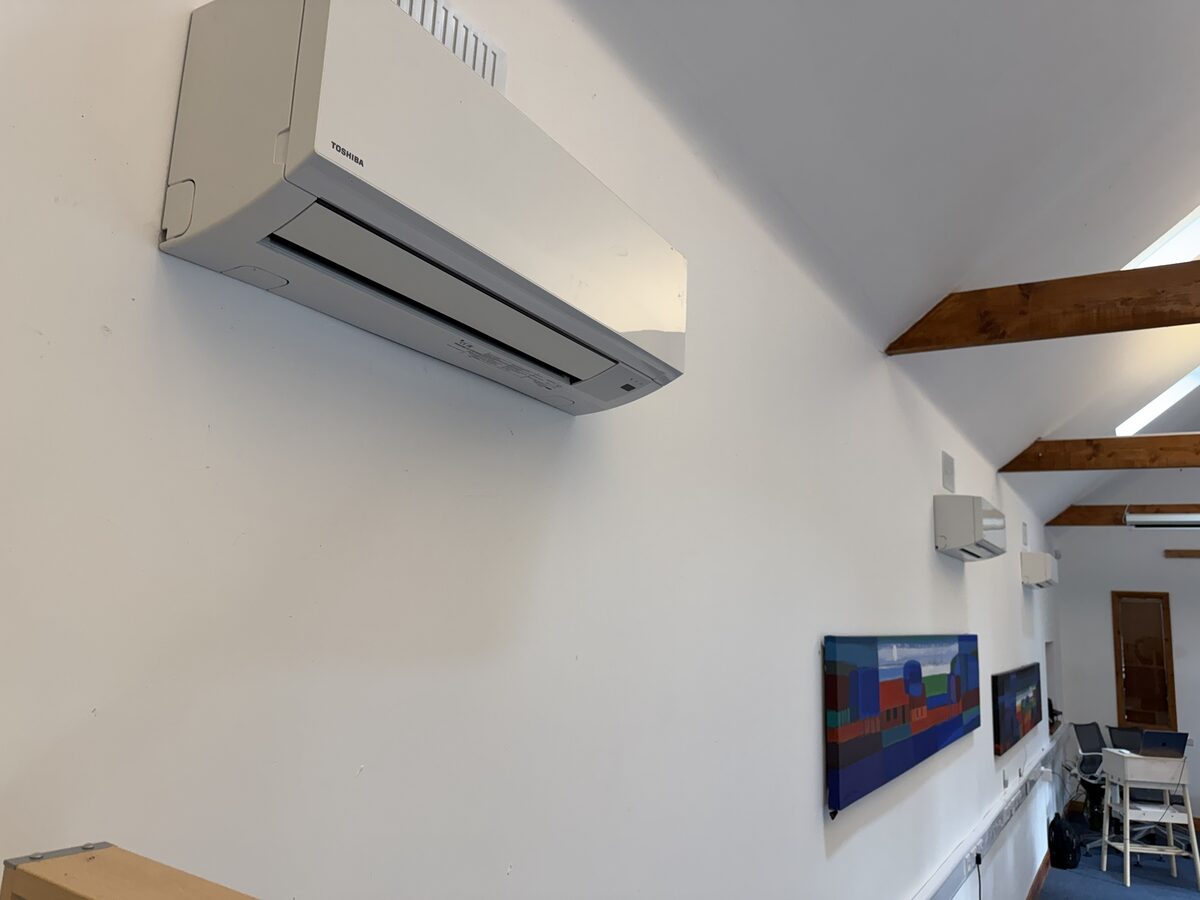
One thing worth explaining, because it is not obvious and most coverage of heat pumps skips it. The air-to-air units draw air down from the top of the room, through the heat exchanger, and discharge it back out at whatever angle the flap is set to.
In a high-ceilinged space with heat stratifying at the apex, the fans alone — before any heat pump work happens — already do useful work by redistributing that trapped warm air down into the occupied zone. In our training room, this is the mechanism that transformed the space. Even if the heat pump never engaged, just the fan mode would drag the warm air out of the V and put it where the people were sitting.
For a room with vertical stratification — a V-ceiling, a mezzanine, a double-height workshop — this is the difference between “warm up high, cold at desk level” and “actually comfortable where people are”. Radiators cannot do this. Air-to-water into underfloor cannot do this at the rate the air-to-air units can.
It is the kind of mechanism that doesn't appear in a brochure comparing nominal COP numbers, but that transforms the lived experience of a space.
The print room — process control, not just comfort
The second install was a different flavour entirely. We have a print room on site with a large folder-inserter, two high-speed colour printers, and all the paper stock we need stored right next to them. We print 250,000 letters a year and the room has to be kept warm and dry, 24 hours a day, 365 days a year. If humidity or temperature drift, the printers jam, paper won't feed through the folder-inserter cleanly, and the downstream cost of a dropped batch is many times the cost of running the climate control properly in the first place.
One 7 kW unit went in. It has been running on full auto for five years with no intervention and no damp-paper incidents since. The reliability data point is the one that surprised me most — this is business-critical infrastructure, and it has simply done its job in the background.
The energy point is almost more interesting. The unit's nameplate is 7 kW of heat delivery. In actual operation, keeping the room where it needs to be, the unit modulates to about 3 kW of real heat output most of the time — and often significantly less. At a measured COP of around 3.5 to 3.8, that works out to under a kilowatt of grid draw for most of the day. The spec sheet reads one way; the actual electricity bill reads another, and it is the modulation that explains the gap.
Any single-figure comparison between an oil boiler and a heat pump that uses the nameplate rating is missing this. The heat pump isn't running flat out. It is a thermostat with a very efficient engine behind it, and most of the time the engine is loafing.
The boardroom — stacked thermal gain, free cooling
The rest of the deployment happened organically, one room at a time, as the pattern established itself. The third install was the boardroom.
We use the boardroom for events with up to twelve people. It sits high in a two-storey section of the building, which is a thermal gift in winter and a thermal problem in summer: heat from the main offices below rises and accumulates in the upper floor, and the room was effectively unusable in July and August.
Two wall-mounted 5 kW units went in. The room is now comfortable all year round — fast to cool, simple to heat, almost instant on both. Twelve people around a table in a sealed room generate real heat themselves; the units handle that load without a hint of strain.
Here's the thing about the cooling, though.
We have 21 kW of solar on the roof. Cooling, in a hot Irish summer, lands almost entirely on the hours when the panels are putting out the most power. Which means the air conditioning is pretty much free — the panels are generating faster than the cooling can consume, and the alternative is spilling the surplus back to the grid.
One of the quiet behavioural shifts of this transition: we never mind using the air con in summer. People who pay for electricity are often reluctant to turn cooling on because it reads as an expense. Solar-covered cooling reads as the opposite — using what would otherwise be exported for a few cents. The boardroom, the training room, the office spaces: on a hot afternoon the cost of comfort is approximately zero, and nobody has to make a judgement call about whether it is worth the bill.
That is the integration argument in one working day. Solar in, cooling out, no meaningful bill between them. Air-to-water would have delivered none of this — because it couldn't deliver the cooling in the first place.
The canteen — the one we got wrong
Next into the fleet was a very high-ceilinged room we use as a canteen on days when training or meetings are running. One 3 kW unit went in. It is fine for its purpose on an ordinary day. On a packed day with twenty people eating lunch, it struggles to keep up.
The honest reason it was undersized: at the time of install, we were still running fossil heating as the baseline for that room, and the heat pump was supplementing rather than replacing. Once the oil came out, the heat pump was carrying the whole load for a space it had never been specified to carry alone.
Time over again, I would put a larger unit here, or two 3 kW units sharing the load, rather than one. It is the single specification call I would reverse.
The main office — the one we got by accident
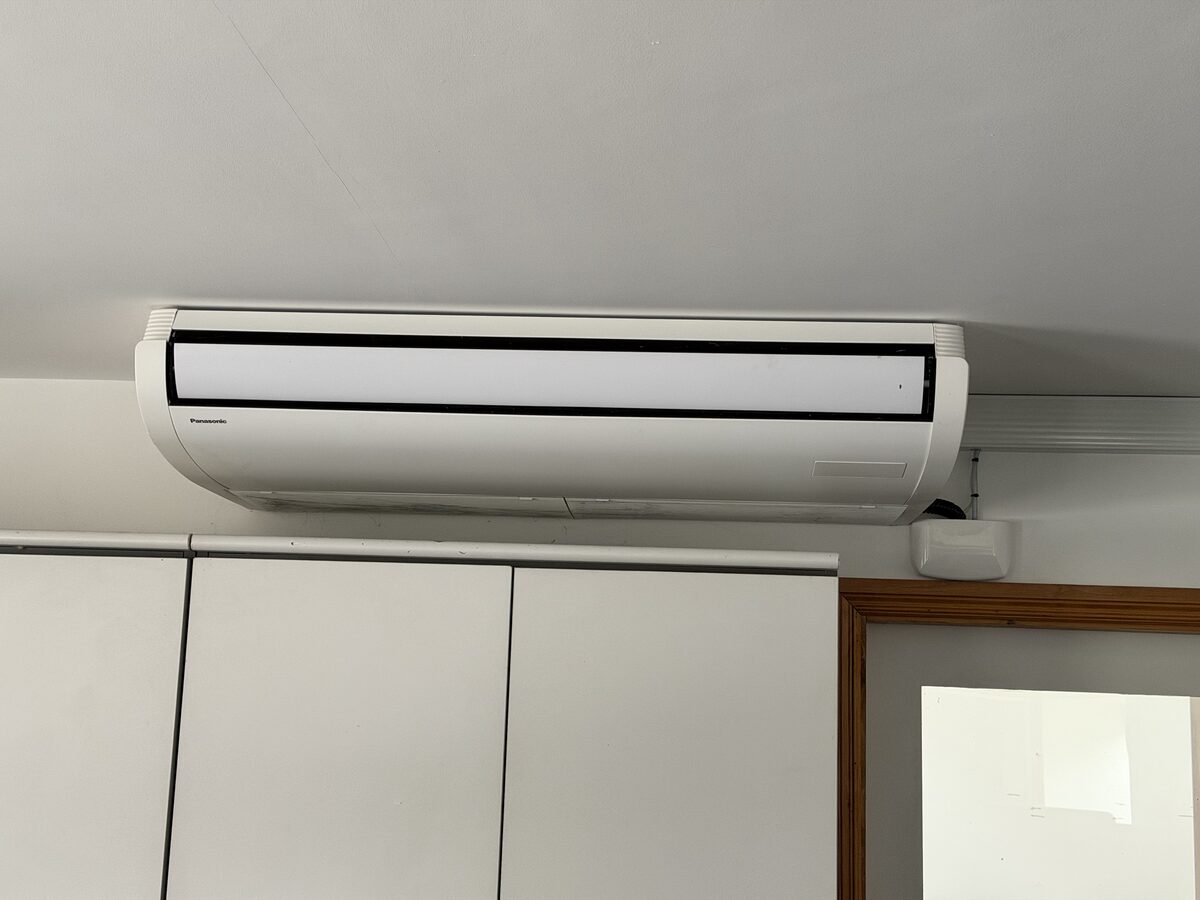
The main-office install came about almost sideways. The room wasn't cold. It wasn't warm. It just was never quite comfortable. People worked in it fine, but there was an itch nobody could quite name.
We put a single 7 kW unit in to move air the way the training-room installs did — expecting a modest improvement, not a transformation. Within days it was obvious something significant had happened. The room went from serviceable to actually comfortable, and the mechanism was partly thermal and partly, we think, the gentle redistribution of air the unit does whenever it is running.
That was the install that let us finish the transition. The main office had been the stubborn case — the one room we hadn't been sure we could cover without a conventional boiler. With that unit in place and performing, the last fossil heating on site came out shortly after.
We had almost not done this install. We hadn't realised what problem it was going to solve until after we'd solved it.
The remaining two — our own offices
The last two installs went into Norrie's office and mine. Both are 3 kW units. Both rooms sit high in the building and share the boardroom's heat-rising problem, so the units earn their keep mostly in summer — cooling the upper-floor rooms when the thermal gain from below would otherwise make them unworkable — rather than as primary heat sources in winter.
That brings the fleet to ten units: three in the training room, one in the print room, two in the boardroom, one in the canteen, one in the main office, one in Norrie's office, one in mine. All air-to-air. All running on the same solar electrons whenever the panels are generating. No fossil heating anywhere on site.
What we replaced
Before the heat pumps went in, the site ran on two oil burners and two 900-litre kerosene tanks. The tanks were refilled at least three times a year each — so the heating fleet was burning in the order of 5,400 litres of kerosene annually, plus whatever the oil burners consumed on top of that.
The outcomes were poor. The system was inflexible, slow to react, and offered zero cooling. That last part matters: the old setup solved exactly one of the comfort problems the site had, and did nothing at all for the other half of the year.
Every litre of fuel came from imports. Every delivery was priced against international oil and gas benchmarks. The burners responded slowly to a change in weather, had to be scheduled around tanker availability, and were effectively silent in July when the overheating offices needed help most.
Running cost, against what came before
A clean comparison is harder than it looks. The heat pumps don't buy fuel separately. They run on the same site electricity meter as everything else, which is in turn fed first by the 21 kWp solar array and the 30 kWh battery before any grid import is drawn. A true "heat-pump-only" running cost would need to allocate a share of on-site solar generation to the heating load. We take an approximate rather than a precise approach to that.
At the whole-transition level, the numbers in the SEAI submission are these: a 63% reduction in total energy delivered to the site across seven years, 100% elimination of on-site fossil fuel, and around 20 tonnes of CO2 avoided annually. Capital spend across heat, solar, storage and transport totalled approximately €139,500, 96% of which was self-funded from company reserves.
One line we want to be honest about. The payback figure we have clean numbers for is the solar array alone, which paid back in about five years. The heat pump component sits on top of that in capital terms, offset against the kerosene it displaced. We were paying around 40 cents per litre of kerosene in 2017 and we haven't bought any since — but at the current Irish price, well above €1 per litre, we would be paying more than double what we were paying then. That price shift tilts the heat-pump-component payback in our favour, more than it would have at 2017 prices. We haven't nailed the combined-system payback figure to a precision we would publish, but the direction is unambiguous.
At the heat-pump-specific level, the structural math is this. A 7 kW unit modulating at around 3 kW of real heat delivery most of the time, at a measured COP of 3.5 to 3.8, draws well under a kilowatt of grid-equivalent electricity for most operating hours. Multiplied across the fleet's working hours — then offset further by the solar generation that coincides with daytime heating and cooling demand — the heat-pump share of the annual electricity bill is a small fraction of what the kerosene fleet used to cost. The exact ratio depends on how you apportion shared solar; the direction is unambiguous.
The move from “every litre is imported, nothing is cooling” to “most of the energy comes off the roof, both halves of the year are solved” is the real story. The specific € figure is downstream of that.
Maintenance — not zero, not high
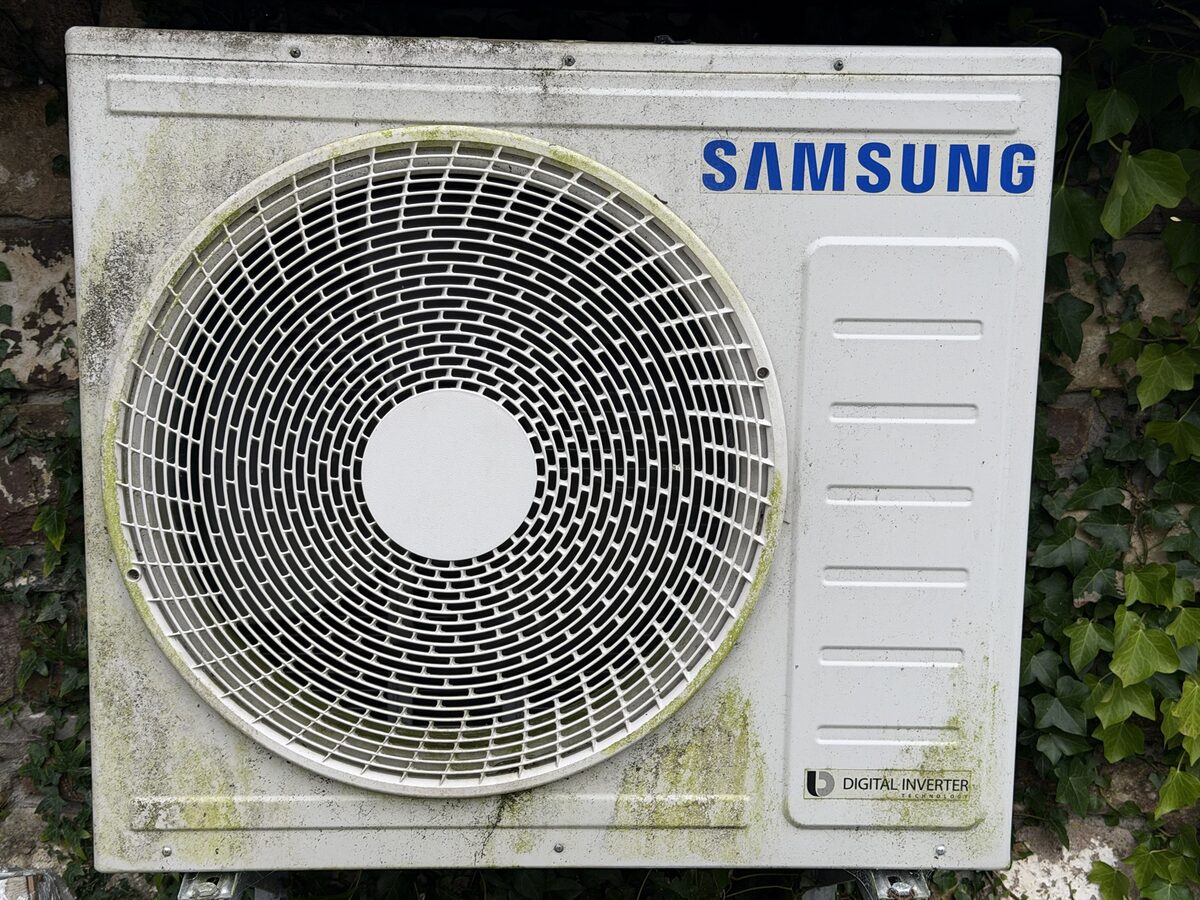
These units do need a little maintenance. Not a lot — but it would be dishonest to call it zero.
The specific one worth naming: the unit in my own office had a porous copper pipe that had to be replaced after it had run out of gas three times before the diagnosis came back as the pipe itself rather than a leak at a joint. Once the length of pipe was swapped, the issue was gone. That is a vendor-component fault, not a design flaw — but it was real, and it happened to one of our ten units.
Beyond that, the ordinary maintenance is filter cleaning done once in a blue moon, plus occasional eyes-on from Richard English's team at Recool — the same company that specified the fleet in the first place. Across the whole ten-unit fleet, annual servicing costs don't even reach three figures a year. The equivalent fossil fleet would have cost many multiples of that in boiler service, fuel safety checks, and incidental repairs on burners, flues and pressure vessels.
The honest version is: these things ask for small, infrequent attention, not scheduled big-money interventions. The absence of burners, flues, injectors and pressure vessels means most of what used to go wrong simply isn't there to go wrong any more.
The cooling receipt we don't have
One honest gap. Someone reviewing this page could reasonably ask for a specific hot-day cooling receipt — a particular July day when the AC side of the fleet kicked in, drew X kilowatt-hours of electricity and cost Y cents to run. We don't have that receipt. And the reason is itself worth noting.
On the days when the fleet is actually running cooling — the warmest stretch of an Irish summer — the solar is producing far more than the cooling can absorb. A training or meeting day runs 09:00 to about 16:00, and the panels are generating for hours either side of that window. The cooling load lands squarely inside the solar day; it never has to come from the grid. What we don't use for cooling goes into charging the EVs instead, or back out to the grid as microgen export.
The absence of a specific cooling-day receipt is itself the receipt. The hot days don't show up on the electricity bill as a line item, because the solar covers them entirely and still has surplus left over for the cars.
Winter — electricity in, three-and-a-half times out
Winter is a different shape. The solar is contributing less, and the heating load is running. So yes, in winter the heat pumps are drawing electricity from the grid.
But for every kilowatt of electricity drawn, the fleet delivers roughly 3.5 kilowatts of heat. That multiplier is the whole point of a heat pump — the electricity isn't being used to make the heat, it is being used to move it. On that physics alone, the winter running cost is a fraction of what the kerosene burners used to cost for the same room temperature.
The other operational advantage people underestimate: no pre-heat. The old system had enough thermal mass and enough response delay that you had to heat the rooms the night before you needed them. The heat pumps don't work that way. You hit the button thirty minutes before a meeting starts and the room is comfortable by the time people arrive. The energy you would otherwise have burned keeping an empty space warm overnight — purely so someone could be in it at 09:00 the next morning — is energy you don't buy at all.
The combined effect of the two halves of the year lands here: as of the end of this summer, we are in credit with Electric Ireland by about €1,100 — after cooling the offices, charging the EVs, and running the business through the whole summer. The microgen export covered everything we consumed and still left that much on the meter heading into winter (generation figures from our Huawei FusionSolar monitoring: 17.46 MWh produced in 2025, 32.7% exported to grid). The heat pumps spend it. The sums land where they should.
What it adds up to
On the direct specification question — would I choose air-to-air again? Every time. Not because air-to-water is a bad technology; it isn't. Because the problem we actually had was comfort across both halves of the year, in buildings that were never built for a hydronic distribution. For that problem, air-to-air wins on every dimension we care about, every time of the year.
But the real answer is bigger than that question.
The heat pumps on their own are a good investment. The solar PV on its own is a good investment. The battery storage on its own is a good investment. The EVs on their own are a good investment. Taken together, they are far more than the sum of their four parts.
The heat pumps alone would still pay for themselves — but at grid electricity prices rather than at zero. The solar PV alone would still generate value — but it would spill its summer surplus back to the grid at the depressed microgen export rate rather than feed cooling and EV charging locally at full avoided-cost. The battery alone would arbitrage the night rate — but without solar to charge from, the arbitrage would be smaller. The EVs alone would still cost less than diesel — but without home solar and the night-rate charge at pennies per kilometre, their running cost would be twice what it is.
Each piece makes every other piece more valuable than it would be alone. The €1,100 credit at the end of this summer is the four systems compounding into one net-positive annual position. The 63% energy reduction across seven years is the same compounding at a different timescale.
That is the point of this page, of agridata.ie/ev.php, of the forthcoming agridata.ie/solar.php, and of the national-scale companion at agridata.ie/vision.php. Each piece on its own is a sensible intervention. Together, they let a small Tipperary business go net-positive on energy and come out ahead financially while doing it.
That is the entire point, both personally and on a national scale.