A century ago, Ireland made an extraordinary decision. We invested in the infrastructure of a future we could scarcely afford, but could clearly imagine.
In the 1930s, my father wanted electric light. The technology existed, but the electricity network hadn't reached him. Rather than wait, he built a waterwheel and generated his own.
Nearly ninety years later, I find myself confronting a remarkably similar question.
In 2018, I set AgriData a target of becoming carbon-neutral by 2025. We haven't quite achieved it. But what we have achieved surprised even me.
We reduced our total energy consumption by 63%. We now generate most of the energy we still require. And the financial benefits of that transition have outweighed the costs — payback came in roughly five years.
We didn't discover a revolutionary new technology. We used existing technologies, invested our own money, measured what happened and adjusted as we went.
What began as an environmental ambition became an exercise in economic common sense.
And it left me wondering.
If a small Irish business can do this, what could an entire country achieve if it decided to approach energy with the same determination?
We are spending money. But what are we buying?
Every year, Ireland spends enormous sums importing the fossil fuels on which our economy depends.
When international prices rise, households struggle, businesses suffer and governments face pressure to intervene.
We reduce taxes, introduce temporary supports and try to shield people from the consequences.
Sometimes those interventions are necessary. People need help today, not in ten years.
But when the money is spent, what remains?
The fuel has been burned. The relief has expired. The next international price shock can bring us straight back to where we started.
We have paid to make the problem more bearable, without necessarily making the problem smaller.
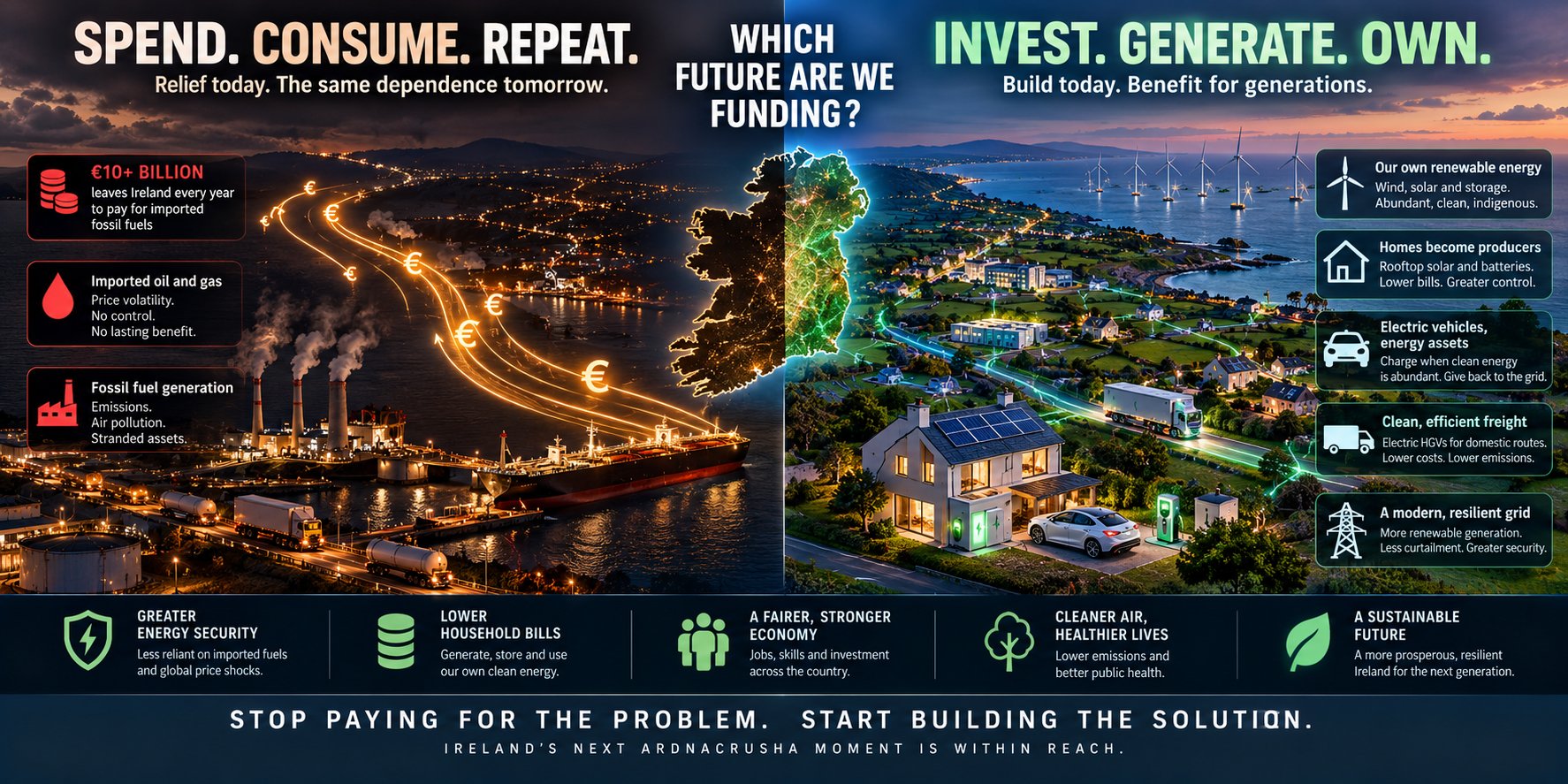
The cost of dependence
We are spending about €1 million an hour on imported fossil fuels.
In 2025, Ireland imported 78.2% of its energy requirements. Fossil fuels accounted for 92.8% of those imports.
During the energy crisis of 2022, Ireland was spending more than €1 million every hour importing fossil fuels, according to UCC energy researcher Dr Paul Deane. That cost varies with international prices, but the underlying dependence remains.
The International Energy Agency estimates that electrifying oil- and gas-based heating and transport could reduce direct fossil-fuel imports by 38%, saving approximately €2.8 billion annually.
That is €2.8 billion a year we could progressively stop spending on imported fuel — and an indication of the enduring economic value of investing in alternatives.
The question is not simply what an energy transition would cost.
It is what continued dependence will cost us if we fail to make it.
Now imagine directing sustained national investment towards something different.
Homes that generate and store electricity.
Vehicles that run on electricity produced here, and can return stored energy when the grid needs it.
Businesses and farms that become less exposed to volatile imported fuel prices.
A modern electricity network that can accommodate the renewable energy we already know how to produce.
And an energy system in which ordinary people can participate, rather than simply paying whatever the market demands.
These are not technologies waiting to be invented. They exist.
The challenge is to make them work together, at national scale.
What Ireland has done well.
The grid operators have been doing the difficult operational work for years. Ireland now runs the second-highest share of wind in Europe (after Denmark); holds the world's highest SNSP limit at 75 percent and is targeting 95 percent by 2030; and has installed the physical infrastructure — synchronous condensers at Moneypoint and Shannonbridge, the DS3 system-services market, new interconnectors — that makes higher renewable shares possible without burning fuel to keep the grid stable.
The charging infrastructure for electrified transport is coming with it. 1,883 fast public chargers by the end of 2025 — 55 percent of the public network, nearly three times the EU-27 average of 19 percent. About two-thirds of CCS connectors are now at 100 kW or above, with motorway hubs operating in the 150–350 kW range. One fast charger for every 54 EVs on the road.
On the ground, drivers can feel it. On the M7 corridor from Limerick to Dublin, high-power hubs now sit roughly 30–50 km apart — Finnegans, Birdhill, Barack Obama Plaza, Portlaoise, Mayfield, the Kill sites, the M50 approaches. Rarely more than 50 km to the next high-power stop.
From a standing start a decade ago, this is a charging network built in parallel with a fossil infrastructure that had a century's head start. It can be improved. Already it beats most of Europe.
That build-out is itself the proof. Ten years is enough time to transform infrastructure if the country decides to do it.
The question isn't whether to start. It's whether to finish.
Five levers. One national mission.
We do not need to solve every aspect of fossil-fuel dependence before beginning. We need to tackle the parts we can change now, in a coordinated way.
- Electrify domestic transport. Make a million electric vehicles a realistic ambition for the mid-2030s, with charging infrastructure and grid integration built alongside them.
- Turn homes into energy assets. Deploy rooftop solar and household storage at scale, with fair access for people who cannot afford the initial investment or do not own a suitable roof — through community solar schemes, energy cooperatives, and tariff- or bill-financed options for renters.
- Make the electricity market genuinely intelligent. The smart-meter rollout is substantially done, but half-hourly data access and genuinely dynamic tariffs are still limited. Give households and businesses meaningful dynamic pricing, smart controls, and payment for the flexibility their batteries and vehicles can provide.
- Electrify the domestic freight we can. Start with the substantial proportion of Irish road freight whose journeys already fit the capabilities of electric trucks.
- Build the grid that makes everything possible. Reinforce networks, deploy storage and grid-stability technologies, and progressively reduce the renewable electricity we currently have to turn away.
None of these measures is sufficient on its own. Together, they offer the possibility of something much more significant: an electricity and domestic transport system progressively insulated from the volatility of imported fossil fuels.
The Ardnacrusha lesson
In 1925, the Irish Free State was a young country with very limited resources.
Yet it committed to the Shannon Scheme at Ardnacrusha, an extraordinary engineering undertaking that helped lay the foundations for national electrification.
The project was controversial. It was expensive. It demanded political conviction and engineering ambition.
But Ireland built it.
And a century later, it is still generating electricity.
The lesson isn't that every ambitious infrastructure proposal is automatically worthwhile.
It is that some of the most consequential national decisions are those that create productive assets whose benefits endure long after the original expenditure.
Consider the scale of that commitment. Ardnacrusha cost about a fifth of annual state spending — the equivalent, in today's budget terms, of around €23–24 billion. We spent that proportion when we were broke and four years old. The investment envelope discussed here is roughly €10 billion over ten years — about one per cent of annual state spending each year. Less than half the proportional courage of 1925, spread over a decade when the technology already exists.
Today we possess technologies that could transform our relationship with energy. We have extraordinary wind resources, increasingly affordable solar and battery systems, sophisticated power electronics and the engineering expertise to integrate them.
What we need is a coherent national plan that treats these as parts of one system.
A national investment, not another collection of grants
I propose that Ireland examine a ten-year national energy transformation programme, with an initial public investment envelope of approximately €10 billion.
That figure is a proposition to be tested, not a final costing.
It must distinguish public expenditure from private investment, quantify the infrastructure required, identify the costs and establish the likely economic returns.
The programme should bring together our best engineers, economists, scientists, energy operators, industry and communities.
It should have measurable objectives, independent oversight and transparent reporting.
And it must be designed so that the benefits reach renters, lower-income households, rural communities and people who cannot afford to invest themselves.
Energy independence cannot become another advantage reserved for those who already have capital.
The ambition is not to eliminate every fossil fuel within ten years. Aviation, shipping, industrial processes and other difficult sectors will remain substantial challenges.
The ambition is to build an electricity and domestic transport system that makes the remaining transition progressively easier, rather than allowing today's infrastructure to become tomorrow's constraint.
The real question
We can debate whether the programme should cost €10 billion or €15 billion.
We can challenge the number of electric vehicles, the balance between household and grid-scale storage, or the most efficient deployment of solar and wind.
We should challenge all of them.
Every assumption should be published. Every calculation should be open to scrutiny. Better ideas should replace weaker ones.
But I believe we should begin with a more fundamental question.
What would Ireland's energy system look like if we designed it today, using the best technologies available, for the benefit of the generations who will inherit it?
And having answered that question, why wouldn't we set about building it?
A hundred years ago, Ireland decided that electrification was worth a national effort.
Perhaps it's time we made another decision of that scale.
Not because the transition will be easy.
Because the cost of remaining dependent deserves just as much scrutiny as the cost of becoming independent.
A century ago, Ireland built the infrastructure to bring electricity to its people. The next challenge is to give those people far greater control over where their energy comes from, what it costs, and how it is used.