The best way to answer "would it work for me?" is not with a brochure. It is with the experience of someone who has been doing it for seven years.
AgriData has run electric vehicles since 2017. In that time we have owned a Tesla Model S, a Model X and a Model Y, added a Mercedes-Benz EQS, and more recently brought a VW ID. Buzz into the fleet. Between them they have covered a lot of Irish and continental road, in all weathers, through winters and summers, loaded and empty.
What follows is what we actually found. Where a figure is from a specific car, we say so. Where it is a pattern we have seen across every EV we have owned, we say that too.
The 88 per cent
Two of our three Teslas came with lifetime free Supercharging. The EQS has free Ionity. If anyone had reason to lean on the public fast-charging network, it was us.
Yet 88 per cent of our charging was done at home, measured by the Tesla app over the full ownership period of the cars that had it. The EQS reads very similar — if anything, slightly higher.
The reason isn't thrift. It is behaviour. A car plugged in overnight at home starts every day full. The free Supercharger is a bonus for an occasional long trip, not a daily habit. The home charger changes the behaviour, not just the price list.
The economics follow. Home charging on our own solar during the day, and on the night rate when the sun is down, works out at roughly one third of the per-kilometre cost of running the equivalent diesel. Not a third less. A third of.
Give a household a charger at home, a solar array on the roof and a dynamic night rate, and the public fast-charging network becomes a convenience, not a dependency. That shifts what the state actually has to build.
Who it doesn't yet work for
The entire argument above rests on a single assumption: you can plug the car in at home overnight. If you can, you wake up every morning with three to four hundred kilometres already in the tank, the car pre-conditioned if you asked it to be, and the electricity paid for at domestic rates during the cheapest hours of the day. The benefit is almost unfair.
If you can't, the picture changes. For people in apartments without charging, in terraced housing with no off-street parking, or anywhere a cable can't reasonably run from a meter to a parked car, the daily routine becomes dependent on the public network — and the public network, however good it has become, isn't yet built around daily reliance. It is built around convenient top-ups between long home charges, not instead of them.
This is a real limitation and it is worth saying plainly. For a meaningful portion of urban Ireland — apartment dwellers, street parkers, people whose car lives at the kerb — the EV is not yet the obvious choice. The infrastructure gap on everyday charging (as opposed to fast charging on the move) is the piece that is still being built out, and it is a slower build than the motorway network has been.
The rest of this page is honest about what EV ownership looks like once home charging is possible. It would not be honest to pretend it looks like that for everyone yet.
Range isn't the question. Charge speed is.
Every conversation about EVs starts with range. In practice, once a car gives you about three hours of real-world highway driving on a full charge, the rest is academic.
You stop anyway. You eat. You use the toilet. You stretch. If the car can replace most of the charge in the time you're sitting down, range stops being the constraint — charge speed does.
That shifts the specification you actually care about. More kilowatt-hours of battery is more weight, more cost, more tyre wear and more energy spent carrying it around. More kilowatts of charge speed is the only number that changes how a long day on the road actually feels.
The thesis is testable at distance. We have done the Tipperary-to-Nice run three times in our VW ID. Buzz, carrying boat-show stand materials and luggage, at French autoroute speeds the whole way — 130 km/h. Each 1,500-kilometre leg from Roscoff to Nice has taken six charging stops plus one overnight. Motorway charging cost per trip: €125. Tolls are €92 each way on top of that, same as anybody else.
The Buzz's DC charging averages 140 kW across a charge cycle and peaks at 204 kW. In theory that gives you two to three hours of driving between stops. In practice I'm 66, and I stop every two hours anyway. The car is capable of more than I am — which is roughly where you want the hardware to sit on a long trip.
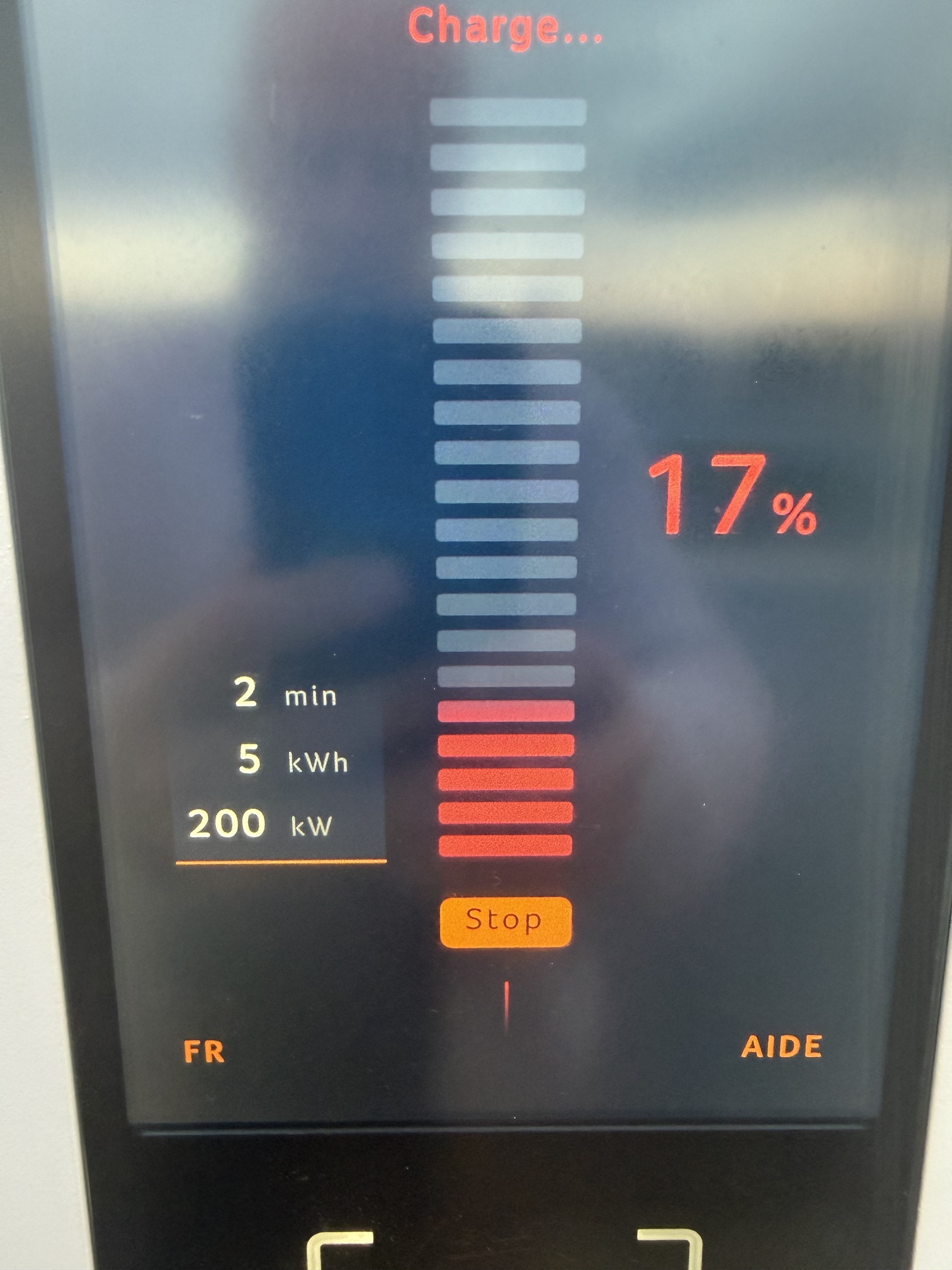 Early in the session: 17% state of charge, 200 kW going in.
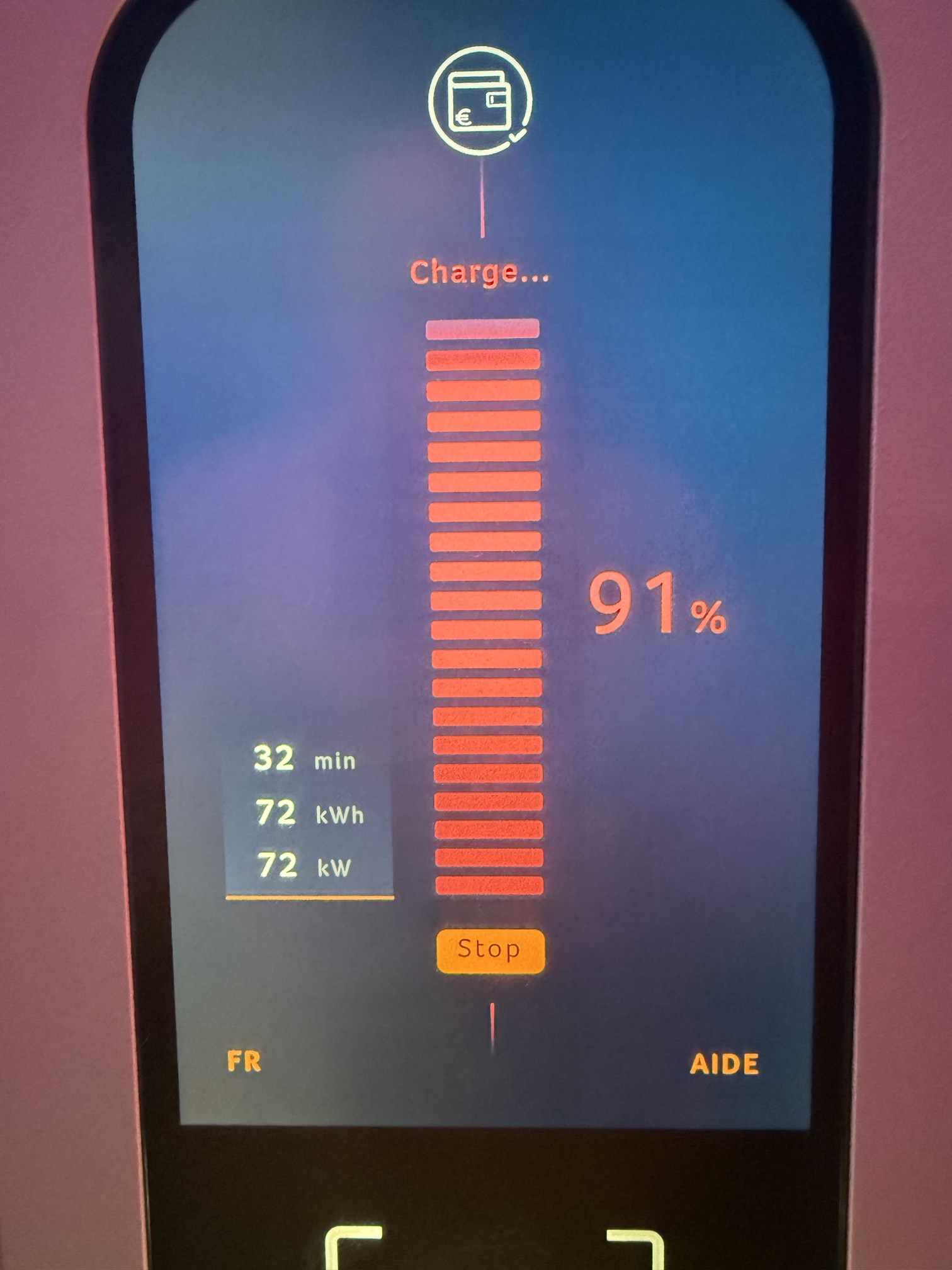 Later in the same session: 91% state of charge, tapered to 72 kW.
To make the point concrete: on one of those trips I got off the ferry at Roscoff in the late afternoon, drove around Paris, and was heading south toward Beaune. By about 21:00 I hadn't eaten, and the Buzz was down to 28%. I pulled into a motorway services, plugged in and ordered a burger. Just as the burger arrived at the table, the VW app pinged to say the charge was complete — I had to rush back out, unplug and move the car before I could sit down to eat.
That is the thesis in one evening. Once the hardware can replace most of a charge in the time it takes to order and serve a meal, range stops being the constraint. In this case the hardware beat the kitchen.
A footnote on the French side of that trip. France has EV charging absolutely nailed. There is a decent charger within reasonable distance of wherever you are, almost everywhere, and motorway rates are competitive — around 34 cents per kilowatt-hour. It is pointless even to plan a route around chargers nowadays. You stop when you want to stop, pick whichever hub is closest, plug in. The infrastructure has moved from present to invisible, which is exactly where you want it.
And the M7 corridor is already there. Hubs 30–50 km apart, most at 150–350 kW. Range anxiety on that corridor is a memory, not a constraint.
Range anxiety is real — and then it isn't
No point pretending otherwise. New EV drivers obsess over the state-of-charge figure for the first couple of months. You check it when you get in, you check it again when you get out, you worry about trips that would never give you a second thought in a petrol car. It is a real psychological phenomenon, not something you can talk people out of.
And then it fades. Somewhere in the first two or three months of normal driving the figure stops mattering. You plug in at home overnight. The car is full in the morning. You go about your day. If you need to charge somewhere unfamiliar, the apps tell you where. The anxiety doesn't get argued away; it just stops showing up, because the daily routine makes it irrelevant.
If you are new to this, give yourself the first couple of months. The watching-the-number phase is normal, and it passes. By month three the state-of-charge figure is just another number on the dashboard, the way the fuel gauge used to be.
Winter driving
An EV warms up in about 500 metres. From a cold start on a winter morning, the cabin is comfortable before you reach the end of the lane. An ICE engine takes kilometres to reach operating temperature; an EV simply doesn't need to.
Better: you can pre-heat the car on mains electricity before you leave. Cabin and battery are already warm when you unplug, and you have paid for that warmth at domestic rates, not at range-reduction rates. The whole exercise costs a few cents, and the car is ready to drive.
The same logic applies to waiting. Sitting in a cold car park while a child's soccer match finishes, you can run the heating indefinitely with no engine running, no idling, no emissions and — crucially — no noise. It is one of the quiet luxuries you don't appreciate until you have it.
When Ireland had its last proper snow and ice snap — a couple of winters ago — the Model Y was about the only vehicle on our road that could travel without getting stuck. Tyre choice is critical in those conditions — a lot of what works in snow and ice is actually the compound and tread pattern on the ground, not what is turning the wheels. On top of that, electronic torque vectoring and dual independent motors can shift drive force to whichever wheel has grip within milliseconds, which is generally faster than a mechanical AWD system can rebalance. On a bad surface that responsiveness adds up.
Whatever the breakdown between tyre and drivetrain, in practice the Model Y made it up a lane where neighbours in mechanical AWD diesels were parked on the main road and walking the rest of the way home. That is the result that stuck with me.
None of this is magic. Range does take a hit in winter — typically 20 to 30 per cent off the summer figure, depending on temperature, driving style and whether you use the pre-heat. But the hit is much smaller on an EV equipped with a heat pump than on one that heats the cabin with resistive electric heating alone. A heat pump moves heat; resistive elements make it from scratch. In Irish winter conditions, the heat pump variant is roughly three to four times more efficient at keeping the cabin warm.
If you are specifying a new EV, specify a heat pump. On an Irish winter commute it is not a luxury trim option. It is almost essential, and the range difference is noticeable within the first week.
Towing
EVs are, slightly to my surprise, brilliant tow vehicles. Instant torque with no slipping clutch gives precise manoeuvring control at low speed; the pulling power at speed is effortless; and the low, central weight of the battery pack keeps the whole combination planted on the road. If you back a trailer onto a tight hitch regularly, the modulation available with an electric drivetrain is a step up on anything with a conventional transmission.
Range takes a beating. Figure about half the normal figure once anything meaningful is on the back. One of our fleet vehicles routinely tows an Ifor Williams 6×12 drop-side twin-axle trailer loaded with wood pellets between Portlaoise and Tipperary — the car does the run in one charge each way, comfortably rather than tight.
One point that caught me by surprise. On the open road, whether the trailer is loaded or empty barely moves the energy figures. The cost is the trailer itself — its frontal area and the turbulent wake it leaves — because at highway speed aerodynamic drag dominates mass. The pellets inside add to acceleration and climbing costs, but far less to cruise than you would expect.
For anyone who tows regularly, the first time you reverse a loaded trailer into a tight spot with an electric drivetrain, the point lands. The range penalty you plan around. The low-speed control, you don't go back from.
Battery, three years in
The Model Y has about 40,000 km on it after three years. Battery capacity degradation measured against the as-delivered figure: 3 per cent.
If that trajectory continues roughly linearly — and the published long-term data from other Tesla owners suggests it tapers rather than accelerating — the pack will outlast the usable life of the car. The manufacturer warranty of eight years and 160,000 km with 70 per cent retained capacity is beginning to look conservative on the ground.
The tyre surprise
My wife Norrie got 55,000 km out of the OEM set of tyres on her Model Y before replacement. She kerbed one, which cut the usable life short — without that, there was realistically another 5,000 to 10,000 km of legal tread left.
That is materially better than the typical performance-car tyre life you would expect for the weight and torque of the car. One factor is drivetrain. On an all-wheel-drive EV, acceleration is distributed across four contact patches instead of two, and regenerative braking is similarly spread across all four wheels. The same forces that would chew through two front or two rear tyres fast are divided across four.
There may be a second factor too. Mechanical AWD systems — centre differentials, viscous couplings, Haldex clutches — can introduce some tyre scrub because they rebalance torque with mechanical latency and some element of slip. An EV with electronic torque vectoring, or dual independent motors, shifts drive force to whichever wheel has grip in a few milliseconds, which may reduce some of that scrubbing. (The same mechanism also helps with grip in snow and ice.)
If that sounds abstract, I had a Land Rover Freelander about fifteen years ago with a permanent viscous coupling between the front and rear drivetrains. It literally chewed through tyres. (The Freelander wasn't an outlier — the permanent viscous couplings of that era had the same inherent constraint whichever marque used them; modern mechanical AWD systems are considerably more sophisticated.) You had to run perfectly matched tyres on all four corners — same brand, same model, same wear state — because any difference in rolling radius forced constant slip through the viscous fluid, and that slip ended up in the tyres. That was an extreme end of the scrub spectrum, not a general rule for all mechanical AWD.
How much of the longer tyre life is actually down to drivetrain effects and how much to alignment, compound, driving style, weight distribution and road conditions is honestly hard to pin down. All of them matter. Norrie's 55,000-kilometre figure is one case on one car; yours will differ with your style and the roads you cover. What is clear is the observed result: the cars don't eat tyres the way the weight and torque would suggest they should.
And when the time does come to replace them, the cost is not an EV penalty. A decent set of Michelin CrossClimate 2 or equivalent — the all-season tyre most of us end up on — runs €176 to €200 per corner, fitted and balanced, on a Model 3 AWD. That is not materially more than the equivalent tyre on a comparable ICE saloon. The horror stories about EV tyre bills are usually about low-profile 20- or 21-inch wheels on performance trims, not what a daily driver actually pays.
Service and tax — the absence costs
A service appointment on an EV is a short conversation. There is no cambelt. No oil to change. No oil filter, no fuel filter, no air filter in the diesel sense. No gearbox or clutch service. No emissions system to worry about.
Brake pads and rotors last three to four times longer than they would on an equivalent ICE. The friction brakes do very little actual work because regenerative braking handles most of the deceleration. The exact multiplier depends on the driver: lift off early and let regen do its job, you may barely wear the pads at all in the first 100,000 km; brake hard and late out of ICE habit, you give some of that saving back.
And a weirdly satisfying one that falls out of the same mechanism: far less brake dust on the wheels. The friction brakes do so little work that the fine black grit which coats the alloys of an ICE car barely accumulates. You notice it when you wash the car. You notice it even more when you don't bother, because the wheels still look clean.
Motor tax is €120 per year, flat. For comparison, the equivalent diesel sits somewhere between €514 and €1,034 depending on CO2 band.
These are what we think of as absence costs — the things you no longer pay for. They are the real saving, and they are also the hardest to notice, because they are invisible by definition. There is no bill arriving for the oil change that didn't happen.
Two financial dimensions we haven't drilled into. Depreciation varies by model and market, and the EV market is still moving fast — some cars have held value better than others, and the figure for any specific car depends on when you buy and when you sell. Insurance was not a problem for us, but others have reported EV cover costing more than the equivalent ICE — it depends on the car, the driver, the location and the claims history. Both are worth running against your own numbers before you commit.
What doesn't change
An EV is not a car that has stopped going wrong. It is a car with a shorter list of things that can go wrong on the drivetrain side. Everything that isn't the drivetrain still ages the same way.
You will still wear out suspension bushes, ball joints, track rods and wheel bearings — the physics of a two-tonne car on Irish roads is the same whichever way it is propelled. Windscreens still crack. Door-lock actuators still fail. Switches wear out. The air conditioning still occasionally needs attention. The 12-volt auxiliary battery still dies on cold mornings.
These are not EV problems. They are car problems, and they are indifferent to the drivetrain. The saving sits on the engine-and-gearbox side of the ledger; the suspension-and-trim side is unchanged.
The app faff is the real friction
This is the honest part. Everything above is better than an ICE equivalent — running cost, service cost, tax, reliability, driving experience. The one thing that still isn't is the user experience of paying for public charging.
Multiple apps. Multiple RFID cards. Different sign-up routines. Different authorisation flows at the charger itself. Different payment methods. Different roaming agreements between networks. It is a mess compared with the hundred years of standardisation that fossil-fuelled drivers have become accustomed to at the pump.
Tesla nailed this from day one. You plug in. The car authenticates itself. You pay. There is no app to open, no card to tap, no phone call to a help line. Every other network is still catching up to that standard. VW's We Charge, Mercedes-Benz's MB Charge Public, and Kia's own charging apps have all improved materially in the last couple of years and are now broadly workable. They still leave a lot to be desired against the Tesla baseline.
What to sign up to before you set off
If you are new to this, these are the apps and operators that actually matter in Ireland and on the European mainland. Register for all of them before you need any of them. Doing it on a wet night at a motorway hub with a child in the back is not when you want to be creating a new account.
- Route planning — A Better Route Planner (ABRP) or ZapMap. Either one is enough. ABRP integrates with most modern EVs and knows real-time charger availability and reliability.
- ESB eCars — the backbone of Irish public charging.
- Ionity — motorway hubs on the European network, 150–350 kW. Essential abroad.
- Applegreen — Irish service stations with 50 kW and 350 kW units.
- EZO (formerly EasyGo) — another Irish operator worth being registered with.
- Tesla — register even if you don't drive a Tesla. The Supercharger network is now open to non-Tesla vehicles on most sites, and it is often the fastest, cheapest and most reliable option when you need it.
- Your car's own charging card and app — We Charge if you drive a VW, MB Charge Public for Mercedes-Benz, Kia's own app for Kia, and so on. These usually bundle preferential rates on partner networks and are the smoothest option when they work.
None of this is complicated once you have done it once. All of it is baffling the first time. If I were onboarding a new EV driver tomorrow, this list is where I would start.
Simpler system, more reliable system
Reliability tends to follow part count. The fewer things that have to work in order for the car to work, the fewer things can go wrong.
An EV is, structurally, a big battery, one or more electric motors, a single-speed reduction gear and a few boxes of control electronics. That is essentially the drivetrain. There is no cambelt. No clutch. No multi-speed gearbox. No fuel system. No cooling system for an engine that isn't there. No emissions system, no exhaust, no catalytic converter, no injectors, no spark plugs, no coolant pump, no turbocharger.
Tesla's own figures, published in July 2025, put a Tesla drivetrain at around 20 moving parts against more than 2,000 in a typical ICE drivetrain. Other industry comparisons sit in similar territory. The specific count varies with what you decide to call a part, but the direction and the scale of the difference are hard to dispute. Every one of those extra components is a potential failure point and a potential bill. Fewer parts means fewer things to break, and fewer things to replace when they do.
None of this says an EV never has a fault. Battery management electronics, high-voltage contactors, on-board chargers and infotainment all go wrong occasionally. But the base rate is structurally lower, and when something does fail there are fewer interdependent systems to investigate on the way to a diagnosis.
You can argue with the specific part count. The direction of the argument is harder to dispute.
The Nokia 6110 question
One analogy struck me on my second Tesla, and I keep coming back to it.
Twenty-five years ago we all had Nokia 6110s. They lasted nearly a week on a charge, took a hammer blow and still worked, and made phone calls that didn't drop. Then the first smartphones arrived and we accepted the trade. We went from a week of battery life to less than a day. We accepted that the device was now fragile. We accepted that it needed charging every night. We accepted that the user experience of what used to be a phone was unrecognisable.
We accepted it because the new device was so transformatively better at everything else that the regression in battery life stopped mattering. Within months it became normal to charge the phone overnight. It became normal to carry a battery pack sometimes. It became normal to charge in the car. The baseline shifted.
And now — would anyone, seriously, go back?
The EV transition is the same shape of trade. You give up some of a metric (range) and some of a familiar routine (filling up when the warning light comes on) in exchange for a vehicle that is structurally better at almost everything else. For the first couple of months you feel the trade. After that, you don't. The baseline shifts. And once it has shifted, going back to a car that is noisier, less controllable, more service-heavy and tied to a volatile imported fuel simply doesn't appeal.
The question isn't whether the EV is better than the ICE on every single metric. It isn't, and won't be, on a few. The question is whether the overall package is so much better at the things that matter day-to-day that the trade-offs stop registering. That is the Nokia 6110 question.
What it adds up to
Seven years. Five EVs. The pattern has been consistent. Lower running cost than any comparable internal-combustion car. Lower service cost. Lower tax. Negligible battery degradation. Tyres that outlast expectations. And a car that is, as a daily driver, materially better than the ones it replaced — quieter, torquier, simpler, cheaper to live with.
None of that is the brochure. It is what seven years of actually doing it looks like.
If the question is "would it work for me?", the honest answer is that for the vast majority of Irish drivers it already does. The infrastructure is in place. The economics have crossed over. The remaining obstacle is the one thing a brochure can't give you: the first week of driving one and realising the brochure was quietly understating the case.
After seven years and five EVs, my own take is simpler. I could not go back to ICE, and I would not want to. There are too many compromises baked into the old architecture, even if the price were equivalent or lower. The EV is just a better car to live with.