The Numbers · Executive Summary

What it cost, what it saves, and whether we'd do it again.

We spent approximately €135,000 over seven years to eliminate on-site fossil fuels at AgriData's Tipperary office. This page is the honest cigarette-packet maths behind that decision — the payback math, the three defensible framings, the benefits the money number doesn't capture, and the one-sentence answer at the end for anyone who asks whether we'd do it again.

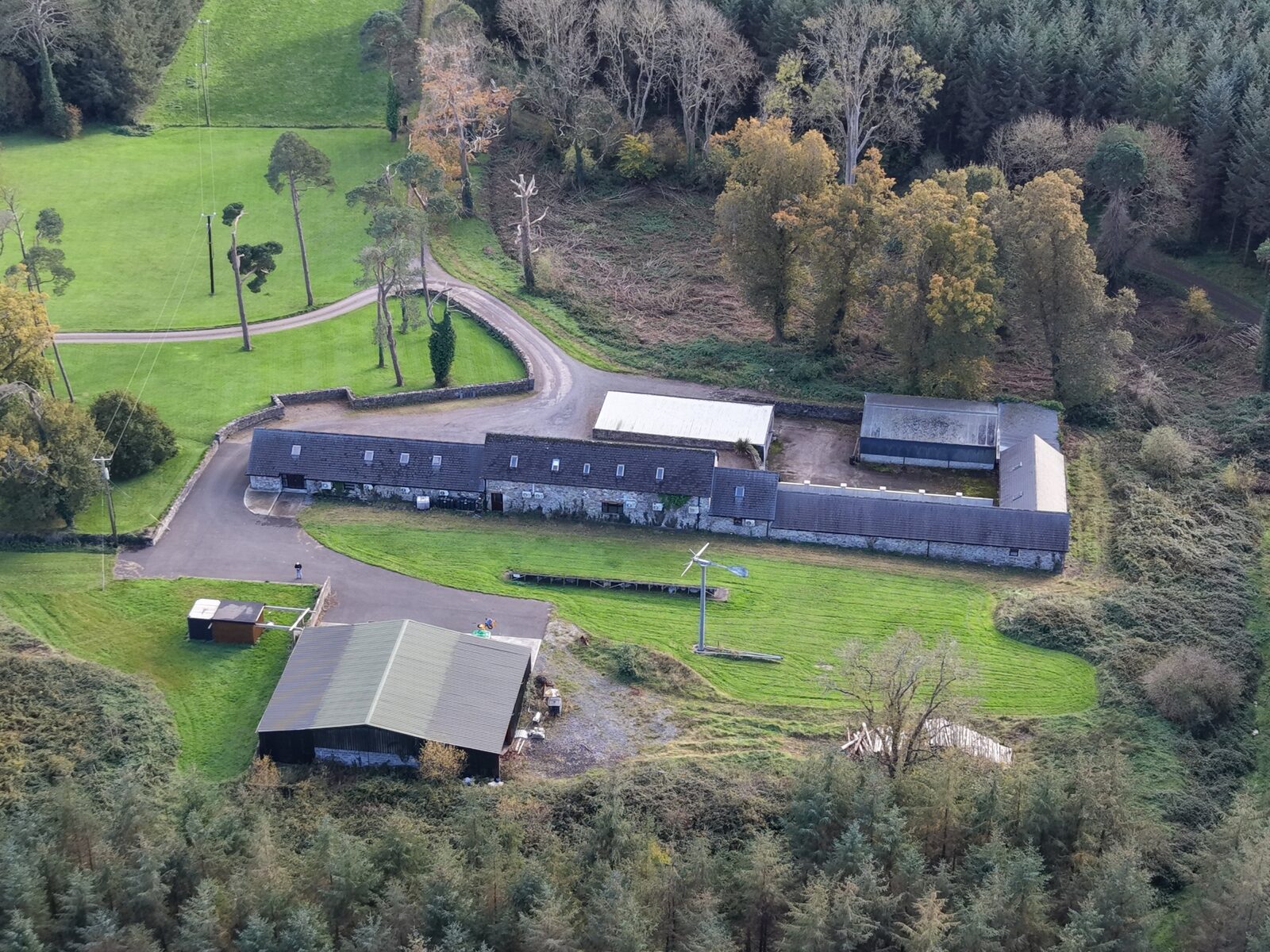
Aerial view of the AgriData site at Cluen, Bansha, Co. Tipperary: restored stone office buildings, the wind turbine that underperformed standing in the yard, surrounded by forestry and farmland on an autumn morning
The site these numbers come from

AgriData's Tipperary office — restored mid-1800s farm buildings on the Smith Barry Estate at Cluen, Bansha. The 2020 wind turbine stands in the yard as the honest reminder it was always meant to be; the solar PV covers the roof slopes; the forestry behind feeds the house's wood gasifier. Every figure on this page comes out of this place.

AgriData · Energy Transition · At 2026 prices

The cost of doing nothing

Before · Fossil-fuel baseline
€20,000
Annual running cost
After · Electrified site
€3,000
Annual running cost
Before €20,000
After €3,000
€17,000
Annual difference
~85%
Lower running cost
6 – 9 yrs
Simple payback range
Illustrative annual comparison at today's prices, using the figures published on the page. "After" cost derived from 10.88 MWh grid import on Electric Ireland Nightsaver autoproducer tariff fixed to 30 June 2028, less 5.71 MWh export at the CEG rate. Full breakdown in the ledger below. Payback varies by accounting method; not a historical realised return.
The line items behind the headline

What makes up the €20,000 and the €3,000

The two columns above are totals — this is what they are made of. The counterfactual column lists what the business would still be buying every year if nothing had changed, priced at November 2026 Irish rates. The reality column lists what has actually replaced it. Nothing is hidden; nothing is averaged away.

The counterfactual

If we'd done nothing — 2018 energy habits at 2026 prices

  • ~3,600 L kerosene burned a year to heat the buildings
  • ~2,750 L diesel burned a year to run the vehicles
  • ~21,000 kWh of grid electricity bought every year
  • Separate air-conditioning plant still needed for print room, boardroom and training spaces
  • Fully exposed to fuel-price shocks (the 2022–23 spike would have added ~€5,000 that year)
  • ~22 tonnes of CO2 emitted every year, directly on site
  • Nothing to fall back on in a grid outage
Running cost, every year ~€20,000 and climbing with every price shock
What we built instead

The reality today — measured, 2026

  • Zero kerosene. Two oil-fired boilers replaced with heat pumps in 2019
  • Zero vehicle diesel. Tesla Model Y and VW ID Buzz on the business meter
  • Net grid import 10.88 MWh/yr (half the 2018 figure, despite running EVs and heat pumps)
  • 5.71 MWh exported to the grid, earning ~€1,140 back
  • Electric Ireland Nightsaver autoproducer tariff contractually fixed to 30 June 2028
  • Cooling built-in to every heat pump — no separate AC plant needed
  • Barely registered the 2022–23 price spike. Shock-protected.
  • ~2 tonnes CO2 residual (grid supply mix only), ~90% reduction
  • Battery backup for most grid outages
Running cost, every year ~€3,000, stable and contractually fixed to mid-2028
Annual difference at today's prices
~€17,000 saved every year · the gap widens each time fossil fuel prices move, and our side is locked until June 2028
01 · What we spent

The Investment: approximately €135,000, honestly broken down

The headline number is €135,000 of capital across the seven years, 96.2% of it self-funded from company reserves and €5,298 from a single SEAI Non-Domestic Microgen grant on the 2024 solar PV expansion. But a chunk of that spend wasn't really a sustainability decision — it was baseline infrastructure that would have been installed anyway, in some form, to make the spaces usable.

Solar PV & battery storage Office roof & wall arrays, 56 panels + 30 kWh storage; house wall array 15 panels + 15 kWh. Expanded 2020–2024. ~€52,000
Heat pumps (central heating replacement) The two 2019 air-to-water units that replaced the oil-fired central heating systems. These are the units that eliminated kerosene. ~€18,000
Heat pumps (space conditioning — baseline infrastructure) 7 units: 7 kW print room, 3 × 5 kW vaulted training room, 3.5 kW canteen, 2 × 5 kW boardroom. These spaces needed heating and cooling regardless — the alternative was oil heating plus separate air-conditioning plant, which would have cost at least this much. ~€30,000
EV charging infrastructure & related electrical upgrades Supply upgrade from ESB, two business-meter chargepoints, cabling. ~€12,000
2020 wind turbine (the one that didn't work out) Installed in good faith, underperformed because of tree cover. Still standing as the honest reminder. ~€8,000
Commissioning, controls, ancillaries, labour over seven years ~€15,000
Total capital over seven years ~€135,000
— of which, honest discretionary sustainability spend (stripping out the baseline-infrastructure heat pumps): ~€105,000

The vehicle costs don't appear in this ledger because we were going to buy replacement vehicles anyway. The Tesla Model Y (2023, replacing a Mercedes GLC diesel) and the VW ID Buzz (2024, replacing a Ford Transit Connect) were running-cost comparisons against their fossil equivalents, not sustainability line-items. Their contribution to the picture is on the savings side — they stopped the diesel bills — not on the capital side.
02 · What we save, every year

The Annual Benefit at today's prices: approximately €18,000

These are the three cost lines the transition made disappear or dramatically reduce, priced at November 2026 Irish retail rates. The solar figure is what our Huawei FusionSolar monitoring system reports for 2025. The kerosene and diesel figures are the counterfactual: what we would be spending now, every year, if nothing had changed.

Solar generation savings FusionSolar 2025 reading. Grid imports avoided plus export revenue. Covers self-consumed PV and 5.71 MWh exported to the grid. €6,400 / yr
Kerosene not bought 3,600 litres at €1.60/litre. Previously burned by two oil-fired central heating systems, now replaced by air-source heat pumps. €5,760 / yr
Diesel not bought 2,750 litres at €2.15/litre. Previously burned by the Mercedes GLC and Ford Transit Connect, now the Tesla Model Y and VW ID Buzz. €5,912 / yr
Total annual benefit at today's prices ~€18,072 / yr

One subtlety worth naming: electrifying the heating and transport added about 15,000 kWh/year of new electricity demand. Some of that is covered by our own solar generation (which is why the FusionSolar €6,400 figure is a net benefit, not a gross one), and some is bought from the grid. The €18,000 figure doesn't double-count — it adds the three savings cleanly — but a fully-netted "like-for-like" comparison lands slightly lower, which is reflected in the third framing below.

03 · How to count it

Three defensible framings of payback

There isn't one "correct" payback period for a project like this — there are honest answers to slightly different questions. These are the three we think bear scrutiny.

The accountant's number

Everything counts

7.5yrs
€135,000 full capital divided by €18,000 annual benefit. Treats every cent spent as a sustainability investment, including the heat pumps that would have gone in anyway. The conservative, hard-nosed answer for a board paper or a lender.
The honest comparable-project number

Strip out baseline infrastructure

~6yrs
€105,000 of discretionary sustainability spend (removing the ~€30,000 of space-conditioning heat pumps that any modern working environment needs regardless) divided by the same €18,000 benefit. This is the right answer for anyone asking "could I do this at my place?" because they'd face the same baseline needs.
The fully-netted consultant number

Account for extra grid electricity

8.5 – 9yrs
Fully netting out the cost of the ~15,000 kWh/year of extra grid electricity needed to run the heat pumps and EVs. The answer for a tedious consultant with a spreadsheet. Defensible, but it ignores that we'd face baseline-infrastructure spend either way.

If forced to pick one number for a one-line answer: approximately seven years at today's prices. It sits in the middle of the three framings, admits both the arithmetic and the real-world messiness, and doesn't claim too much or short-change the real work.

One nuance worth owning rather than hiding: fuel prices in 2018 were about half today's — kerosene around €0.65/litre, diesel around €1.35/litre. Our lived payback over the actual seven years was slower than the today's-prices calculation suggests, because the early years saved less in cash terms. So the "seven years at today's prices" headline is really a statement about the resilience of the investment at current energy costs — which happens to be the exact question anyone considering a similar project today is actually asking.

04 · What the money number misses

Two benefits that don't appear in the payback calculation

A pure cash-payback calculation strips out everything that isn't a direct Euro saving. Two of the most valuable outcomes of this project aren't in the €18,000 figure at all. Honest accounting acknowledges them in a separate column, not by inflating the main number.

Cooling is a two-for-one that didn't need separate funding

The alternative to those 7 space-conditioning heat pumps wasn't "oil boilers for the same rooms" — it was "oil heating plus a separate air-conditioning plant for summer." Print rooms, boardrooms, vaulted training spaces need cooling in modern working conditions. The heat pumps collapse two systems into one: one install, one commissioning, one maintenance contract, two seasons of comfort. An honest counterfactual would have added at least €15–20,000 of air-conditioning capital and the ongoing cost of running it. None of that appears in the payback number because it was never a direct substitution — it was a two-for-one that quietly didn't need to be funded.

Energy-shock insulation is insurance you've already collected on

The 2022–23 fossil-fuel price spike doubled kerosene and nearly tripled diesel over a six-month window. Any Irish small business running on oil heating and diesel vehicles took that hit directly to the bottom line; many are still recovering. Our site barely registered the event because the input to our energy stack was almost entirely sunlight, with a small residual grid draw. That's a real, cashable form of risk reduction — not just carbon, but balance-sheet resilience, with the receipts already in hand.

And the forward view is harder still: our Electric Ireland Nightsaver autoproducer tariff is contractually fixed until 30 June 2028. We know what the next twenty months of our electricity bill will look like. Anyone still buying kerosene and diesel for the same period knows only what today's price is — and the market has moved by double digits on less provocation than it is likely to see over the next two years.

05 · Live Proof · November 2026

The screenshot that answers "but what about winter?"

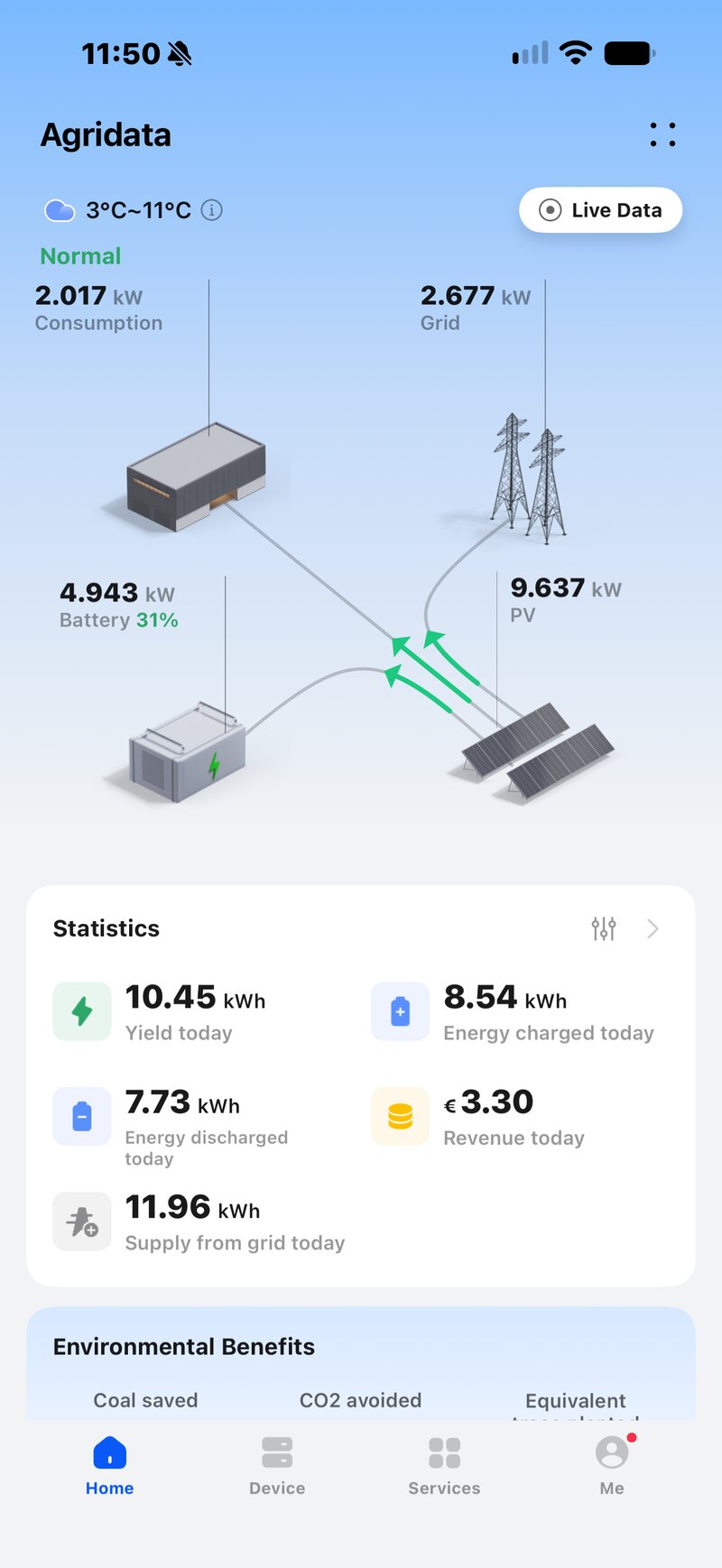
Second of November, 11:50 in the morning. Grey Tipperary sky, 3–11°C, early winter proper. The depth of the solar off-season by every ordinary assumption about Irish weather.

And the system is quietly pulling 9.637 kW off the panels, running the whole building on 2.017 kW, charging the battery at 4.943 kW, and pushing 2.677 kW back out to the grid. By 11:50am, the day has already earned €3.30 of revenue.

The numbers in that screenshot
9,637 W generated · 2,677 W exported
PV producing more than site consumption plus battery charging combined. Battery at 31% and climbing. Yield today: 10.45 kWh (and climbing). Self-consumption rate 92.63%. The flip from "net importer" to "actively exporting" happens most mornings before noon, even in November.

If someone asks what Irish solar does in November, the honest answer isn't an argument. It's this picture, with the clock in the corner and the arrows pointing to the grid.

FusionSolar monitoring app showing 9.637 kW of PV generation, 2.677 kW being exported to the grid, battery charging at 31%, on a cold overcast November morning at 11:50am

Huawei FusionSolar app, Monday 2 November 2026, 11:50am. Live data from AgriData's business meter.

06 · The strategic one-sheet

Where we are strong, where we are honest, where it goes next

The compressed version of this whole page, for anyone who prefers to see trade-offs in four quadrants rather than seven sections of ledger. Nothing here is spin — the weaknesses and threats are listed with the same honesty as the strengths.

Strengths · what the receipts actually show

What's working

  • 100% elimination of on-site fossil fuels, verified against primary records
  • 96.2% self-funded (€134,202 of €139,500 from company reserves)
  • Independently measured: Huawei FusionSolar + Electric Ireland + accounting records
  • Already shock-protected — 2022–23 fuel spike barely touched us
  • Electricity cost contractually fixed to 30 June 2028 — forward price certainty for 20 months while fossil-fuel buyers remain fully exposed
  • Cooling built-in to every heat pump as a free second function
  • ~20 tonnes CO2 avoided per year, ~90% reduction from baseline
Weaknesses · where we're honest about limits

What's still true

  • €135k upfront capital is a real barrier for smaller SMEs without reserves
  • Seven-year payback is longer than many commercial ROI horizons
  • Site is still a net importer of electricity (10.88 MWh/yr, not off-grid)
  • The 2020 wind turbine was a bad decision we leave standing as a reminder
  • Expertise required: we are engineers; most owners aren't
  • Equipment lifespans beyond ten years still an open question
Opportunities · what gets better from here

What's compounding

  • Battery costs still falling fast — further expansion viable at lower capital
  • Each fuel-price shock makes the resilience benefit more valuable
  • Export tariffs for small producers are gradually improving
  • Model is replicable at almost any similar small-business site in Ireland
  • Our data and documentation can shortcut the next business's decision
  • Policy voice on vision.php may unlock supports we didn't have
Threats · what we're watching

What could go wrong

  • SEAI grant landscape could tighten (we got only one grant — €5,298 — in seven years anyway)
  • Export tariff rules could change against small producers
  • Grid supply mix changes could shift the carbon-saving math
  • Equipment reaching end-of-life would require re-capitalisation ~2032–2035
  • Larger businesses with better scale may undercut SME replicability
  • Regulatory risk around rural micro-generation remains live
The question anyone considering this actually asks

Would we do it again?

Hell yes.

Seven years in, with the receipts on the page and the November-morning monitoring data on our phones, there is no scenario in which we would un-make this decision. The payback math is defensible. The resilience benefit has already been collected on. The two-for-one of cooling-in-the-same-box is a quiet gift that keeps on giving. And the quality of the working environment — air that moves properly, heating that just works, vehicles that start every morning for a tenth the fuel bill — is a different, non-financial dividend that doesn't appear in any ledger.

If anything, the honest regret is that we didn't move faster between 2018 and 2022. The best year to have done this was always three years earlier than the year you're reading about it.

Talk to us about doing this at your site →

David Mullins and Norrie Mullins · AgriData Ltd, Bansha, Co. Tipperary · First published 2 November 2026