Seven years, two phases, 56 panels, 30 kWh of storage, and one lucky-accident grid headroom. This is the system that makes every other piece of the transition work. The EVs run on it. The heat pumps run on it. The battery stores it for the evenings and arbitrages the night rate in winter. Without it, each of the other measures is still a good investment — just a smaller one. With it, they reinforce each other.
System
- Office hardware
- 56 panels · 21.66 kWp DC · 30 kWh Huawei Luna2000 storage · 3 Huawei inverters + per-panel optimisers, EPS backup box, and ancillaries
- Phases
- Phase 1 — Solar Electric, commissioned May 2020 (20 Sharp 300W panels, 6 kWp). Phase 2 — SolarSmart Energy Limited, commissioned August 2024 (36 Jinko 435W N-Type panels, 2 Huawei inverters + 1 more on a separate order, 10 kWh Luna2000 at install, expanded to 30 kWh ~six months later, EPS backup box for server-circuit UPS).
- Grid connection
- Single-phase 128 A supply · 21 kW MIC (import headroom from a 2018 cost-saving choice at ESB).
- Also powered by this array
- 2 heat pumps and 2 EVs — full stories at agridata.ie/heatpump.php and agridata.ie/ev.php.
- House (separate family install)
- 15 × 500W vertical wall panels (7.5 kWp, south face) · 15 kWh Sonnen battery with Sonnen inverter — not grant-aided, see the wall-mount section below.
Outcomes — 2025 full year
- Generated
- 17.46 MWh
- Used on site
- 11.75 MWh (67.3% of PV generated)
- Exported to grid
- 5.71 MWh (32.7% of PV generated)
- Share of total site demand met by PV
- 41.8% (remaining 58.2% imported)
- Grid position
- Net importer of ~10.7 MWh over 2025. Not a net exporter of kWh; financially net-positive (€1,100 billing credit after summer).
- The one that didn't work
- 6 kW wind turbine (2020) — site survey missed mature tree cover; included honestly in the SEAI submission.
Before any of this — the 2007 precedent at the house
The business story starts in 2018. The family story goes back further. The house is a 1745 Georgian building with the usual thermal challenges. Before 2007 we were spending about €3,500 a year on kerosene and were still cold. That year I replaced the oil system with a 50 kW wood gasifier (fed from the property's own forestry), 2,000 litres of buffer storage, and 8 m² of evacuated tubes for hot water — about €18,500 installed, running cost now around €650 a year via a Coillte timber partnership. By 2018 the install had paid for itself more than twice over.
It takes physical work — loading the gasifier isn't setting a thermostat — but the playbook (generate on site, store locally, avoid imported fuel, do the work) was not theoretical when the business-scale decisions began. It had eleven winters of evidence behind it.
The Tesla flipped something fundamental
I had the Tesla Model S from early 2018. The driving experience itself is covered on the EV page, but the bigger shift was simpler: once a viable alternative to burning fossil fuels existed, continuing to burn them felt wrong on almost every level. The 2007 house system had already shown what was possible at smaller scale. That mental flip preceded every physical install that followed at the business.
€26,000 vs €900 — the ESB story
We wanted a second EV charger. A three-phase upgrade was quoted at €26,000 — eye-watering for a small Tipperary business. ESB Networks offered a single-phase 128 A supply for €900 instead. We took it. It was installed mid-2018.
What we didn't know at the time was that the upgrade had quietly come with a 21 kW Maximum Import Capacity. MIC is the contractual import ceiling — separate from the mini-generation export permission (NC7), which is governed on its own terms — but the practical consequence of oversized MIC is that the inverters we later installed could be sized against that cap without triggering an expensive network upgrade. That accidental headroom made the Phase 2 solar expansion feasible on the connection we already had.
The 2025 target takes shape
The first heat pumps went in in 2018 and worked beautifully from day one (the experience for that is at agridata.ie/heatpump.php). Watching the oil demand fall, with a Tesla on the drive and a 128 A single-phase now live, the arithmetic started to look like it could add up.
I set the carbon-neutral target at 2025. The date was arbitrary — I had no particular reason to pick 2025 over any other year, except that it felt not quite impossible. That was the whole criterion. Not quite impossible.
The target, in writing — November 2019
In November 2019, in reply to a routine query from ESB Networks Tipperary about export-meter paperwork for an increased-supply application, I committed the target to writing to an outside party. Reproduced here verbatim:
“The export side of things is less relevant for the moment — I'd be much more keen on the increased MIC / night rate / 3 phase side of things for the moment. We have no microgeneration in place as yet, but are actively looking at this — Photovoltaic / Battery storage, wind or water turbine generator.”
“Internally, we have set a goal of trying to be 100% carbon neutral by 2025 — whether this is achievable or not is open to debate, but I'm going to have a good try anyway.”
That is the whole project in two paragraphs, dated and sent, years before any of the lived experience existed. The list of candidate technologies in that first paragraph — photovoltaic, battery storage, wind, water turbine — is the menu we worked from. Three of the four were installed (photovoltaic, battery storage, and wind); the water turbine remained on paper only, and the wind turbine underperformed. More on that further down.
Why solar came next (late 2019)
By late 2019, with two heat pumps running and a Tesla charging at home, the electricity bill had started to climb visibly. We'd shifted load off the oil tanker onto the electricity meter — good news in principle, less good when the bill arrives. The next logical move was to generate some of that electricity on site rather than buy all of it.
I started looking at solar in late 2019. The money seemed not crazy.
Phase 1 — Solar Electric, February to May 2020
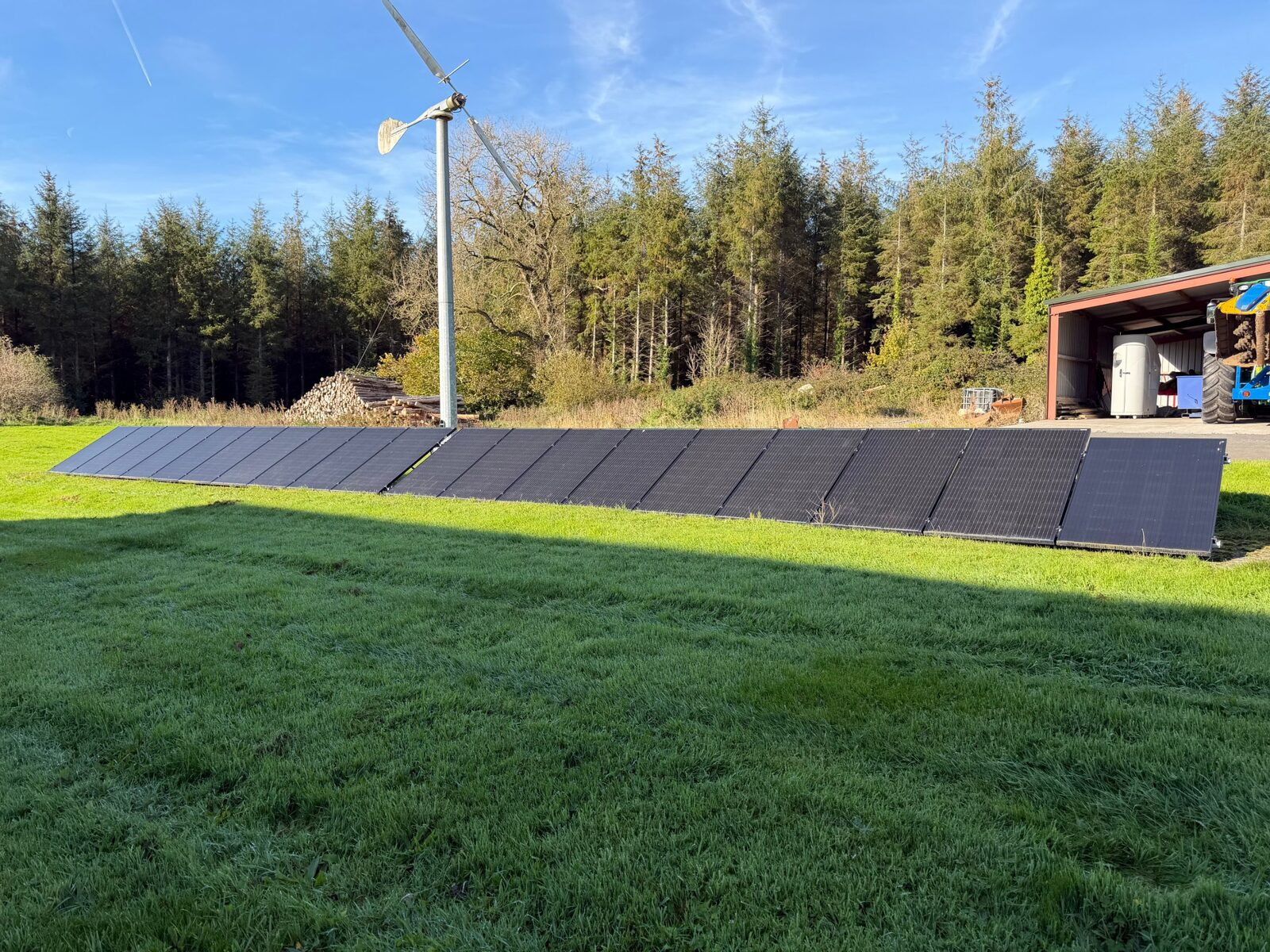
Solar Electric, a Wexford-based installer, quoted on 21 February 2020. The specification was a 6.0 kWp ground-mounted PV array — 20 Sharp 300 W panels on a landscape frame — paired with a Sonnen eco.9.53 Hybrid 15 kWh battery system. Typical generation estimated at 5,400 to 6,000 kWh per year.
Total cost: €18,971 including VAT at 13.5% (€16,715 ex VAT plus €2,257 VAT). No grant was available on that job — this was before the current round of the SEAI Non-Domestic Microgen Scheme opened.
I ordered it. Six weeks later, in May 2020, mid-COVID, the panels and battery landed. The system started producing immediately. The first thing that struck me was how little drama was involved: a ground-mounted array of 20 panels and a cabinet in a utility room, and the import meter started reading lower from day one.
Learning TOU — the night-rate trick
What I didn't expect, and what took the first winter to understand, was that the battery was useful for a reason I hadn't bought it for. The obvious use case was the one I'd planned around — soak up daytime solar surplus, discharge it into the evening load. In an Irish winter, with short grey days, the solar contribution falls off a cliff and the battery looked redundant.
Except it wasn't. The battery also handled the arbitrage against time-of-use pricing. Charge it cheaply overnight on the night rate; discharge it into expensive daytime load. The battery was useful every day of the year, not just the summer ones. That realisation reshaped how I thought about storage going forward. A battery isn't a solar accessory. It is a general-purpose load-shifting tool that pairs with solar in summer and with the night tariff in winter.
Phase 1 ended up covering about one-third of total electricity needs over its first full year of operation. That was enough to be interesting, not enough to be transformative. It was obvious that more would be better — if the grid connection could take it.
Phase 2 — SolarSmart Energy Limited, 2024
I met Richard Godsil of SolarSmart Energy Limited, a Dublin-based PV and battery installer, and we hatched the Phase 2 upgrade plan. Add 36 more panels to the existing 20-panel ground-mount array for a total of 56 panels, plus new storage and new inverters sized against the 21 kW MIC. We also commissioned SolarSmart to install a solar + battery system at the house.
The original Phase 2 design, as hatched with SolarSmart, was more interesting than it ended up being. We planned to keep the existing Phase 1 system in the office intact — the 20 Sharp panels, the Sonnen inverter, the 15 kWh Sonnen battery — and add two Huawei SUN2000-5KTL inverters alongside it for the 36 additional ground-mount panels. On top of that we wanted a dedicated UPS-type switchover for the server and computer circuits, running off the Sonnen battery pack.
The reason for the UPS matters. We have frequent short power outages at this location — four or five a year on average, lasting anywhere from ten seconds to ten days. We have a large on-site diesel generator, but it takes several seconds to start and switch over, during which the network crashes and the servers lose state. A battery-backed UPS on the server circuits bridges those seconds cleanly and keeps the business running through the generator start sequence. SolarSmart engineered the UPS logic around the Sonnen battery — not a typical UPS architecture, but one they made work.
So the mixed-vendor plan was deliberate. Sonnen keeping Phase 1 generation and running the UPS. Huawei handling the Phase 2 inverter capacity for the expanded ground-mount array. The house, meanwhile, would get its own simple single-vendor Huawei system with its own inverter and battery. Three Huawei inverters bought in total across both sites: two for the office upgrade, one for the house.
The Sonnen/Huawei swap — forced apart to make either one work
Then the office install happened first, and we discovered the thing nobody mentions in the glossy brochures. The Phase 1 Sonnen inverter and the new Phase 2 Huawei inverters refused to work together. Not a tuning problem — a vendor-stack problem. Energy-management decisions made by one vendor got overridden by the other, batteries got charged at the wrong times, system behaviour was unpredictable, and the UPS function the whole architecture had been designed around was compromised. The hybrid plan was dead.
This was a problem of a different scale than ordinary incompatibility. The house install, importantly, hadn't started yet.
The only sane decision was to split the vendors geographically. Move every Sonnen component — inverter and 15 kWh battery — out of the office and over to the house, where it would stand alone as a clean single-vendor system with nothing to argue with. Install the already-purchased Huawei kit that had been destined for the house at the office instead, letting the office go coherent all-Huawei end to end. SolarSmart re-engineered the UPS function around the Huawei battery stack rather than the Sonnen one — a second atypical UPS architecture built on a different battery vendor but delivering the same server-circuit protection against the four-or-five annual outages. The result: the house got the Sonnen as a clean standalone install; the office ended up with three Huawei inverters rather than the two originally speced, running as a coherent all-Huawei stack with a working UPS on the server and computer circuits.
One further detail we only fully understood after the fact. SolarSmart fitted per-panel optimisers across the whole array — the new 36-panel Phase 2 stack as a matter of course, plus a retrofit on the original Phase 1 20-panel ground mount and on the house wall-mount. The reason optimisers matter in an Irish site — and why we'd under-weighted them going in — is that per-panel MPPT means a single shaded, soiled, or under-performing panel doesn't drag down the whole string. In mixed-weather Ireland, where cloud shadows roll across a 56-panel array constantly, that effect compounds. The glossy sunny-day yield figures don't capture it, and the retrofit was worth every penny.
This is a pattern you only see in retrospect: the problems that look like obstacles at the time of install turn out to be the steps that resolve into the architecture actually working the way it was going to need to work. The Luna2000 battery at the office was later expanded to 30 kWh total about six months after commissioning, once we understood the TOU and self-consumption load better. The house got the Sonnen it was always going to be fine with. The already-purchased Huawei inverter that was meant for the house found its way into the office stack rather than being returned or shelved. Nothing was wasted — the office ended up with more inverter capacity than originally planned, and the optimiser retrofit lifted the Phase 1 ground array's winter performance measurably.
The paperwork completed on 21 August 2024, when SolarSmart Energy Limited signed the ESB Networks NC7 Mini-Generation Installation Confirmation Certificate for the full combined install. That is the dated moment Phase 2 went live and the office system reached its current configuration.
The house wall-mount — winter-first solar, no grant
Alongside the house's Sonnen battery install, we also commissioned a 15-panel wall-mounted PV array (15 × 500W = 7.5 kWp) on the south face of the house. Vertical — or almost vertical, with a slight lean-back off the stone wall. It fell outside the SEAI grant eligibility criteria we had met for the roof arrays — anyone considering something similar should confirm current grant rules with SEAI directly, as the schemes evolve.
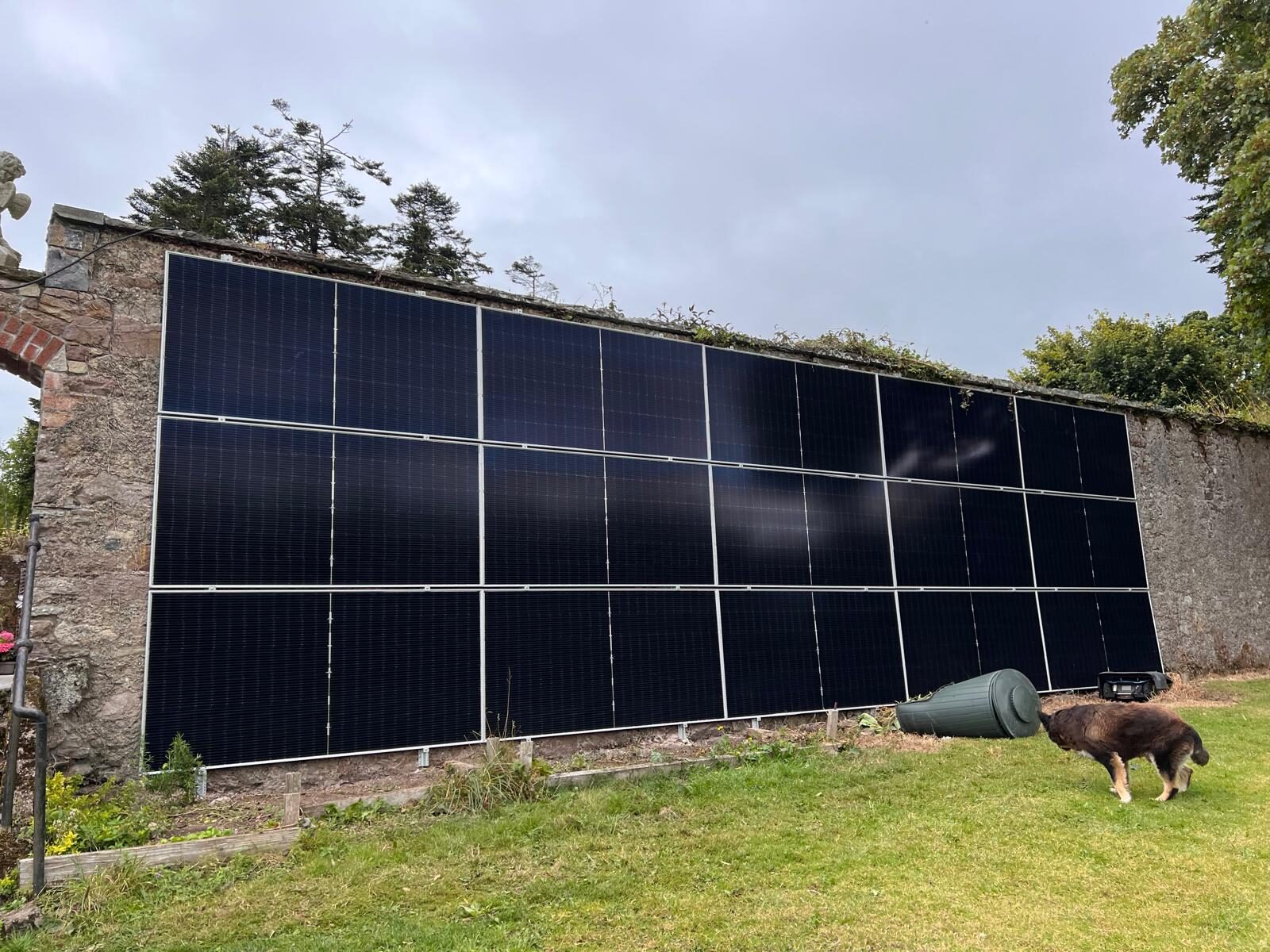
The thinking was deliberate. A roof-angle array optimises for annual yield, which in Ireland is weighted toward summer. Summer is the half of the year when solar is least useful to a house: long days, low heating load, export rates below retail import rates. Winter is when the household actually needs the electricity most — short days, high heating and lighting load, and the sun is low in the sky at a shallow angle. A south-facing vertical panel catches that low winter sun closer to head-on than an equivalent roof-angle panel does.
The trade-off is explicit. A south-facing vertical face favours low-angle winter sunlight at the cost of annual yield. The wall array underperforms a conventional roof-mount on an annual-kWh basis; in deep winter, when the household load is at its peak, it often outperforms the roof-angle equivalent on the hours that matter. On a frozen January day the wall panels are frequently the only ones on the entire family site generating anything useful. Orientation, roof pitch, diffuse light and shading all affect the comparison — this is the trade we made for our site, not a universal recommendation.
What the Sonnen app actually shows — the winter-first argument meets data
The house system was commissioned mid-2025 (first production data in the Sonnen app from July 2025) so a full calendar year isn't on the clock yet. What we can say from the Sonnen app's own figures:
- Jul–Dec 2025 (first six months live): produced 4,392.1 kWh, consumed 3,296.1 kWh on site, imported 1,424.1 kWh from grid, exported 2,174.7 kWh to grid.
- 2026 year-to-date, May–Oct: produced 3,460.1 kWh, consumed 2,421.2 kWh on site, imported 953.3 kWh from grid, exported 1,677.2 kWh to grid. The 2026 monthly bars run roughly 245 kWh (May) / 400 kWh (Jun) / 490 kWh (Jul) / 380 kWh (Aug) / 360 kWh (Sep) / 335 kWh (Oct). January through April aren't shown yet in the app's year view because the capture starts later in the year.
- Winter performance, Nov–Dec 2025: ~180–280 kWh per month at the darkest point of the Irish year, against ~390–400 kWh monthly grid import on the house circuits. The wall array didn't carry the whole winter load (nothing in Ireland does, at that latitude in December), but it kept producing when a conventional roof-angle equivalent at the same latitude would have been close to zero.
The winter-first argument is no longer theoretical. The vertical face is still producing in November and December. An annual-yield figure in a single number can't see that because it rewards summer peak; a monthly breakdown can. The engineering reasoning was strong enough for our site that we did it anyway, without the grant. Non-grant-aidable isn't the same thing as wrong.
Where we are now
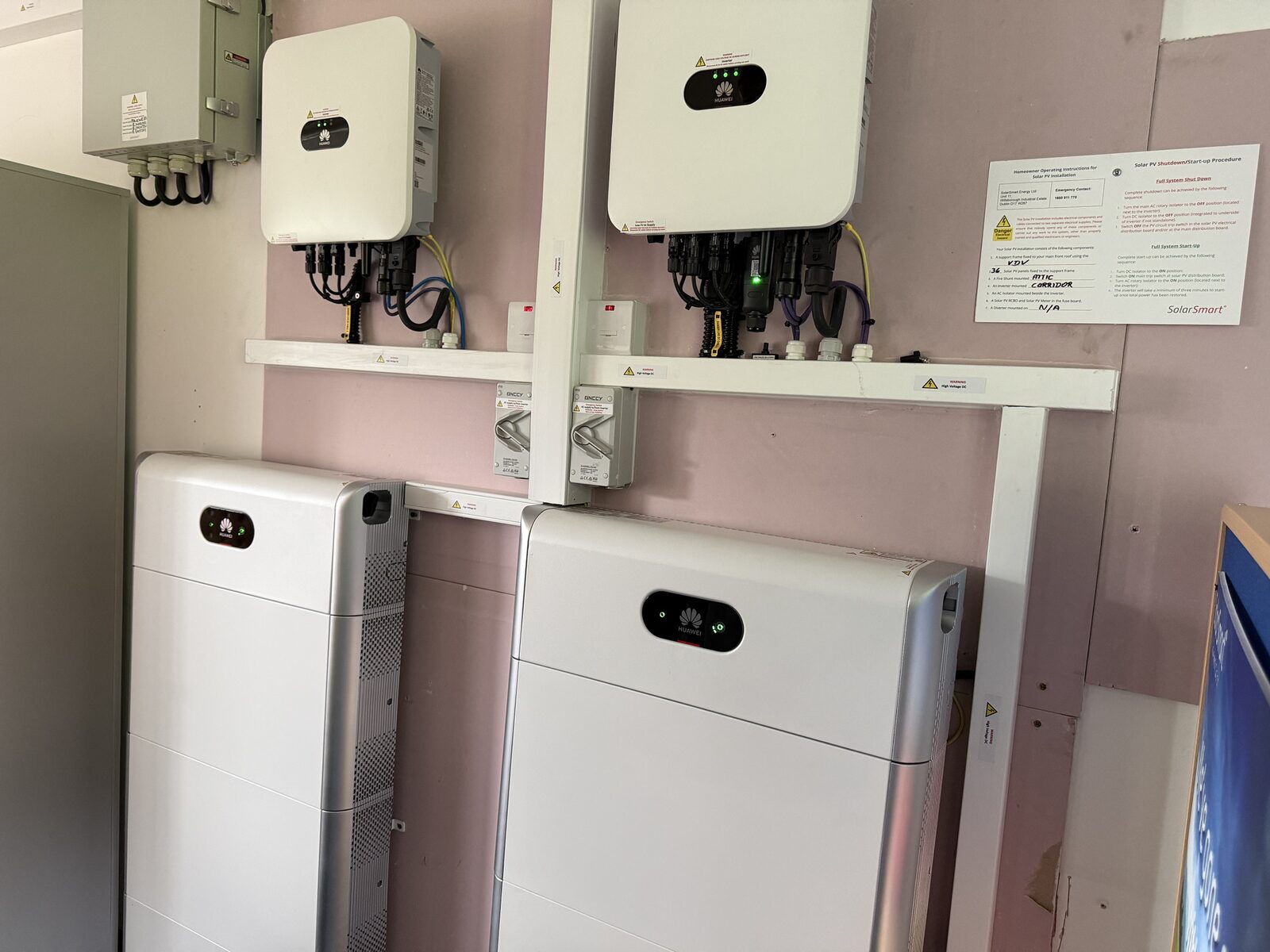
Current office configuration, five years after the first panel went up:
- 21.66 kWp of solar PV across 56 panels (20 Phase 1 Sharp + 36 Phase 2)
- 30 kWh of Huawei integrated battery storage
- Three Huawei inverters in the office stack (two SUN2000-5KTL from the original Phase 2 spec, plus the inverter originally destined for the house that was redirected to the office after the Sonnen/Huawei swap)
- Dedicated UPS switchover for the server and computer circuits, running off the Huawei battery pack — bridges the generator start sequence during the four-or-five annual power outages at the site
- Single-phase 128 A supply with a 21 kW MIC
- Microgen export agreement with Electric Ireland
- Monitored continuously via Huawei FusionSolar
- Phase 2 was the one install across the entire seven-year transition that received a grant: the SEAI Non-Domestic Microgen Scheme
What the system actually delivers
From Huawei FusionSolar meter data for the 2025 full year:
2025 solar performance at a glance
Where the 2025 PV generation went
Total office consumption 28.13 MWh — PV directly reaching the load was 11.54 MWh (41.03% of site demand); grid import was 16.59 MWh (58.97%). The gap between 11.75 MWh self-consumed (production-boundary — everything that didn't leave the meter, including PV → battery) and 11.54 MWh reaching load from PV (consumption-boundary — what actually fed appliances after battery round-trip losses) is ~0.21 MWh — the expected round-trip loss on ~30 kWh of storage over the year. Both figures are correct in their frame. 67.3% is the self-consumption rate of what the array produced; 41.03% is the share of site demand that PV directly fed.
Netting imports and exports, we were a net grid importer of ~10.88 MWh over 2025 (16.59 MWh imported − 5.71 MWh exported) — a substantial on-site generator, but not a net exporter of electricity across the year. Huawei-calculated revenue for the year (self-consumption value + export income) came to €6.47k.
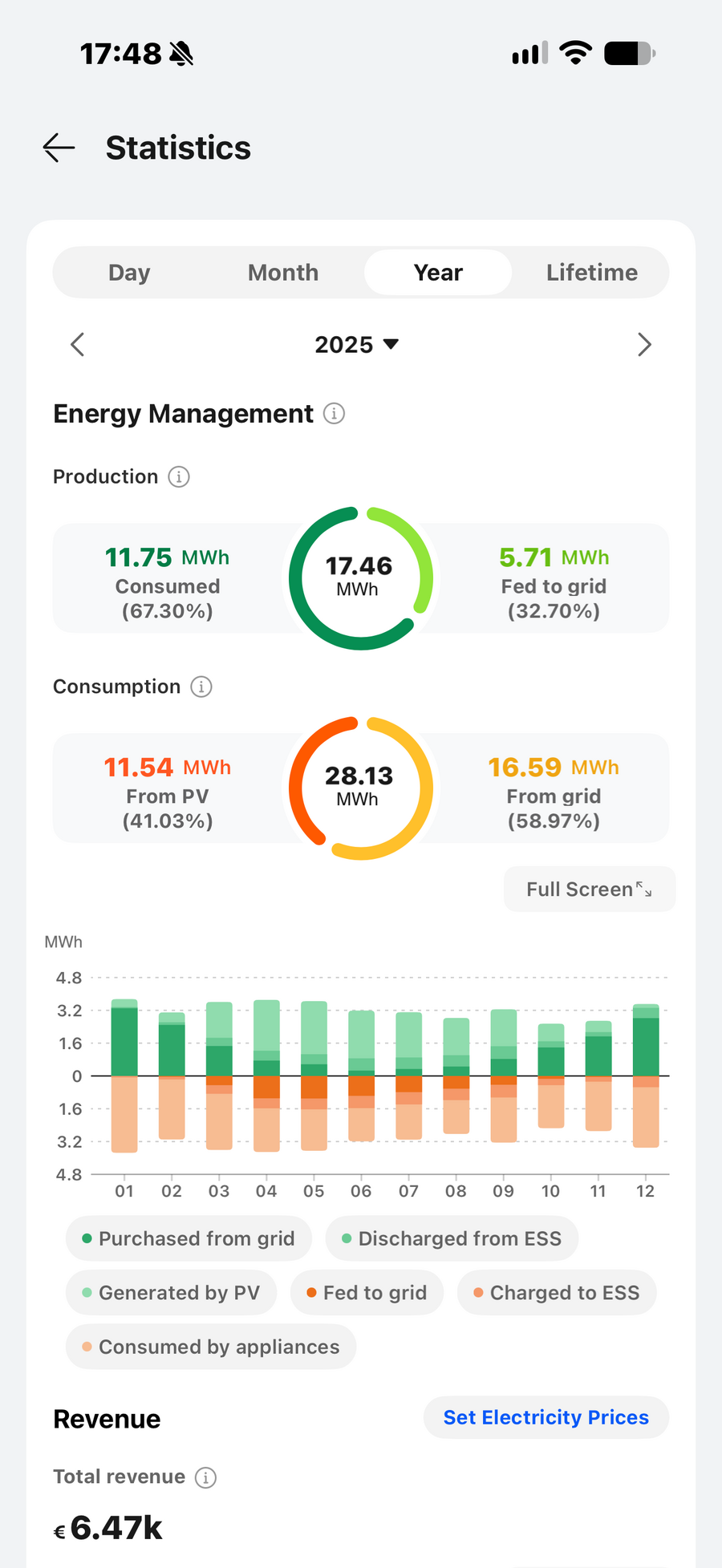
Primary source · Huawei FusionSolar app, 2025 full year
Every 2025 figure in the panel above is lifted directly from the Huawei FusionSolar monitoring platform that logs the office array live. Screenshot taken on this device, 23 October 2026, year view set to 2025.
Production donut: 17.46 MWh generated, split 11.75 MWh consumed on site (67.30%) and 5.71 MWh fed to grid (32.70%). Consumption donut: 28.13 MWh total site load, 11.54 MWh from PV (41.03%) and 16.59 MWh from grid (58.97%). Total revenue €6.47k. All figures metered, not modelled.
2026 year-to-date, through October: 16.53 MWh produced (already on pace to exceed 2025's full-year 17.46 MWh), €4.59k revenue year-to-date, and PV covered 46.07% of total site demand (vs 41.03% in 2025). The export share of generation is also up (37.13% vs 32.70%) — both ratios rose because the Phase 2 array, now running its first full year at steady state, generates comfortably more than the site's instantaneous load even with the EVs and heat pumps on it. More PV reaches the load and more surplus goes to grid during peak solar hours. 2026 is turning out to be the first full year of what the system is actually capable of.
By the end of this summer, after cooling the offices, charging the EVs and running the whole business, Electric Ireland was carrying a €1,100 credit balance on the account. That is a billing-timing figure — a snapshot of export income minus import costs at that point in the cycle — not an annual energy surplus. It's a real financial outcome, and a satisfying one, and worth noting that the balance was in our favour after a full summer of heavy site load. It isn't the same thing as being a net exporter.
The financial picture — two phases, seven years, business and family side separated
What the solar story actually cost, in rounded numbers, from the invoices and quotes on file. The business-side figures are the SEAI Awards submission scope; the family-side house install is shown separately for honesty rather than hidden inside the business totals.
Install costs, grants and net spend
From the Solar Electric (Phase 1) and SolarSmart (Phase 2) quotations and the SEAI non-domestic microgen grant records.
| Phase | Period | Installer | Hardware | Install cost (inc VAT) |
Grant | Net cost |
|---|---|---|---|---|---|---|
| Business — AgriData Ltd (SEAI Awards submission scope) | ||||||
| Phase 1 (office) |
Feb–May 2020 |
Solar Electric | 20 × Sharp 300W panels (6.0 kWp) + Sonnen eco.9.53 Hybrid 15 kWh battery with Sonnen inverter · ground-mount | €18,971 | None | €18,971 |
| Phase 2 (office) |
Dec 2023 → Aug 2024 |
SolarSmart Energy Ltd | 36 × Jinko 435W N-Type panels (15.66 kWp) + 36 × Huawei 450W optimisers + 2 × Huawei SUN2000-5KTL-L1 inverters + Luna2000 10 kWh battery + Huawei EPS Backup Box (server-circuit UPS) · ground-mount | €34,504 | €5,298 (SEAI Non-Domestic Microgen) |
€29,206 |
| Post-install additions |
Late 2024 → early 2025 |
SolarSmart Energy Ltd | 3rd Huawei inverter (originally invoiced for the house, redirected to the office after the vendor-stack swap) + Huawei optimiser retrofit on the Phase 1 20-panel ground array + Luna2000 battery expansion from 10 kWh to 30 kWh | On file | — | On file |
| Family — house install (shown separately; not part of the SEAI business submission) | ||||||
| House wall-mount |
Commissioned mid-2025 (first data July 2025) |
SolarSmart Energy Ltd | 15 × 500W vertical wall panels (7.5 kWp, south face) + per-panel optimisers + Sonnen inverter (relocated from office) + 15 kWh Sonnen battery (relocated from office) | On file | None | On file |
How to read this. Hard numbers come from the Solar Electric
quotation (dated 21 February 2020, Project Ref 2020XD63623) and
the SolarSmart Energy Ltd updated quote (#3513378, dated 15 December 2023,
installed August 2024 with NC7 Mini-Generation Installation Confirmation
Certificate signed 21 August 2024). The Phase 2 SEAI Non-Domestic
Microgen grant figure is €5,298 — the only grant
received in the entire programme. Post-install additions and the house install
are on file as additional invoices.
Business-side headline: ~€48,177 net on the two main
solar/storage invoices (Phase 1 €18,971 + Phase 2 €29,206 after
grant), plus the post-install additions on file, against a 2025
measured value of €6,470 for the year (self-consumption value +
export income, Huawei FusionSolar). Simple payback on the solar array portion
is in the region of five years.
Why there's no 2020–2024 line-by-line. 2025 is our one
fully-metered year with usable self-consumption and export figures. Earlier years
existed, exported and saved on fuel too, but reconstructing them line by line
would be modelled rather than measured. The page's honesty rule is that we
don't invent numbers we can't produce from the meters, so the 2025 figure
stands as the demonstrated run-rate and the earlier years are described in
the narrative without a hard annual column.
The one that didn't work — the wind turbine
Honesty requires one more section. The November 2019 email listed four candidate microgeneration technologies: photovoltaic, battery storage, wind, and water turbine. We tried three of them. One of the three has underperformed consistently and we have included it honestly in the SEAI submission rather than quietly omitting it.
In 2020 we installed a 6 kW wind turbine on site. The site survey didn't properly account for the mature tree cover around the property, and in operation the turbine has delivered a small fraction of its nameplate potential. The surrounding trees take enough energy out of the airflow that there isn't much left for the blades.
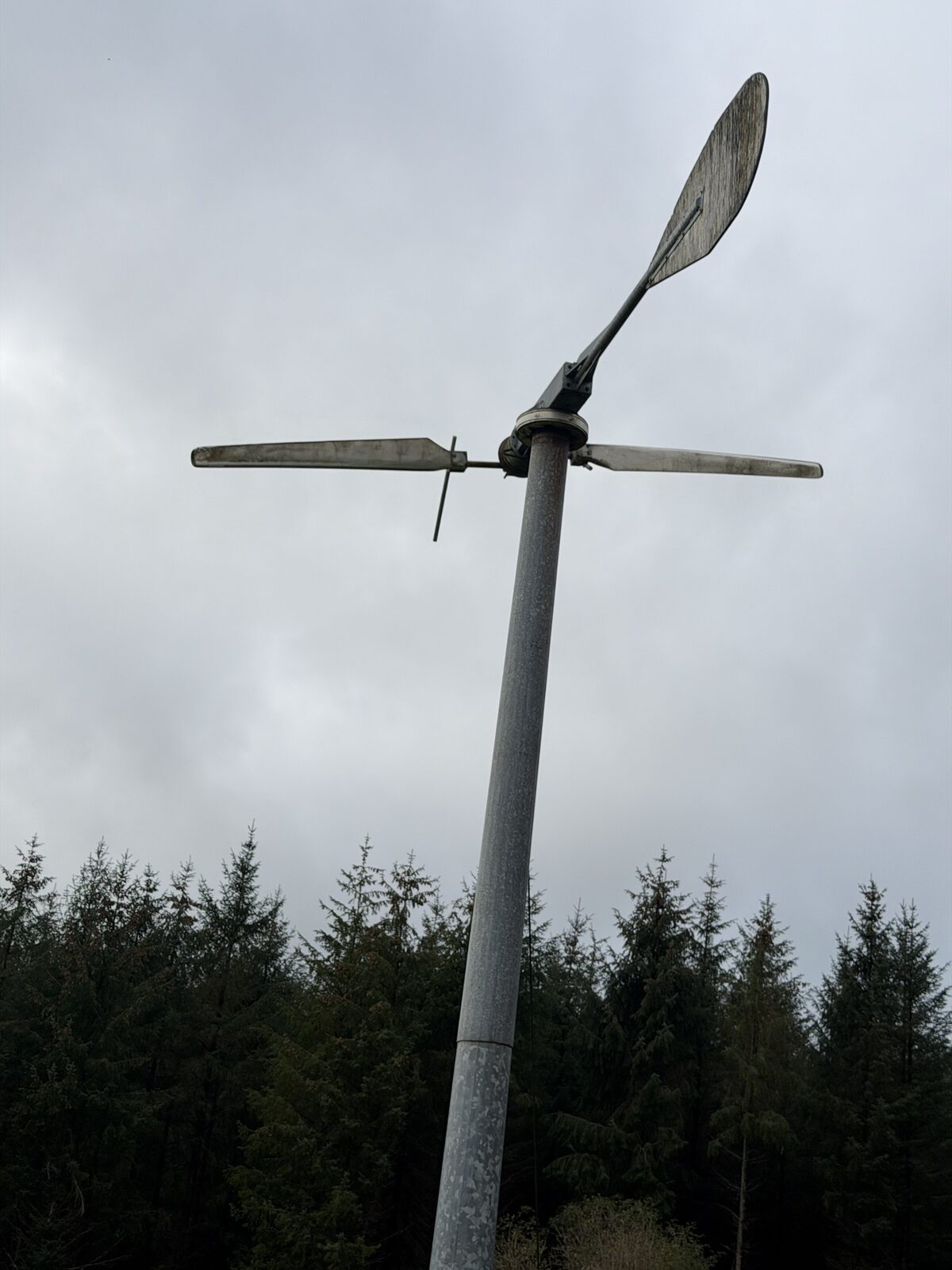
It is the one install in the seven-year transition we would not do again in the same spot without a much more rigorous site survey. The lesson is specific: turbines near mature tree cover need a wind-speed data campaign at hub height over at least a full year before any commitment, not a visual assessment on a good day.
We include it in the SEAI entry and in this page not because it is embarrassing but because its absence would be. The ones that didn't work deserve the same accounting as the ones that did.
The quiet transition — tools, grounds, and everything else
One category of change doesn't get written about in energy transition coverage, because it happened too gradually to notice. Nearly everything else on the site that used to burn petrol, diesel, or run on pneumatic air lines has quietly gone electric alongside the big installs.
Grounds maintenance. We have 14,000 square metres of grass across the site. Keeping it cut used to mean three-and-a-half hours a week bouncing around on a diesel ride-on mower — expensive to buy, expensive to fuel, expensive to maintain, and not much fun to spend an afternoon on. Now the week-to-week work is handled by electric robot mowers running continuously. The grass is simply maintained, not cut-and-recut on a weekly cycle. One side effect of continuous light cutting rather than weekly heavy cutting: the grass stays healthy enough that there is no weed or moss build-up. No chemicals, either. The mechanism change took care of the problem the chemicals used to be solving.
One honest caveat. The diesel ride-on has not been retired entirely. The robots do the maintenance; the ride-on still comes out for the first cut of the season, when the grass has grown out over winter beyond what the robots can keep up with in continuous mode, and for the occasional missed cut when the robots have been thrown off their routine. It is a pain in the arse — quite literally — but it is a necessity for perhaps two or three outings a year. What used to be a 3.5-hour weekly chore has become an occasional one, which is a materially different thing even if it isn't zero.
Power tools. At this point almost nobody is still using mains-powered electric drills, pneumatic impact drivers, or pneumatic angle grinders on a working site. The transition to Li-ion battery packs is essentially complete across professional tool categories. And the outcomes aren't just “as good as” the older equipment. Impact drivers, specifically, are noticeably better than the pneumatics they replaced, kilogram for kilogram — more torque, more control, no air lines to drag around, no compressor to run in a corner of the workshop.
Leaf blowers. Who would trade mixing petrol with two-stroke oil, slopping it into a noisy, smoky little engine, pulling a starter cord in the vague hope the thing will even catch — for simply inserting a battery pack and pressing a button? The two-stroke garden-equipment era is quietly ending because the battery version is just better.
Mowers, drills, drivers, grinders, blowers, hedge trimmers, chainsaws, pressure washers — all of them now charge off the same solar electrons that power the heat pumps and the EVs. Every load on site that used to be fossil has stepped onto the electricity meter, and the electricity meter is in turn increasingly covered by the panels on the roof. The transition isn't just the big things. It is the small things, in quiet aggregate.
On “carbon neutral”
We have not had a full independent carbon-neutrality assessment covering Scope 1, 2 and 3. That is worth saying plainly.
What we can demonstrate from meter data and primary records (figures calculated and evidenced for the 2026 SEAI Energy Awards submission):
- 100% of routine on-site fossil fuel eliminated — a backup diesel generator remains for grid outages (we lose power 4–5 times a year, ranging from 10 seconds to 10 days) and a legacy diesel ride-on mower still comes out for first and last cuts of the season; neither is in routine use
- Substantial on-site generation — 41.8% of site demand met by PV in 2025; the remaining 58.2% imported from the grid
- €1,100 billing credit sitting with Electric Ireland after summer (a billing-cycle snapshot, not an annual energy surplus)
- Approximately 20 tonnes of CO2 avoided annually on an operational basis
These are defensible against the meters. None of them is the same as full “carbon neutral” across the entire value chain. Grid imports still carry some fossil content, the equipment has embodied carbon (panels, inverters, batteries, EVs all cost something to make), and there are other leaks (consumables, supply chain, travel, end-of-life vehicles) that a proper Scope 3 assessment would surface.
One honest note on the embodied-carbon piece, because it matters: standard lifecycle accounting shows that for PV in a European climate the avoided operational emissions outweigh the embodied emissions comfortably over the equipment's lifetime. What no amount of on-site generation can do is retroactively erase the carbon that was already emitted to build the kit — that carbon is historical and in the atmosphere. It's a timing distinction, not a case against solar. The net lifecycle balance is positive; the embodied share is just paid up front rather than year by year.
Until that fuller assessment exists, the claim we stand over is “net-zero on-site fossil” — a meter claim — rather than carbon neutral in the strict sense.
Why solar is the piece that compounds everything
Solar is not the fastest standalone payback of the four measures. Heat pumps generally return capital quicker, and EVs are cheaper to run from day one. Battery storage on its own is mainly an arbitrage tool.
But solar is the piece that makes the others more valuable than they would be alone. In summer the heat pumps and EVs run on electricity whose marginal fuel cost is zero — the kit is paid for, so the running cost of the kilowatt-hour is nothing beyond the capital already in the ground. The battery stores surplus for the evening and shifts load against the night rate in winter. The summer billing credit noted above is the result of those interactions compounding, and the energy reduction across seven years is the same effect over a longer period.
Without the solar, each other measure is still sensible. With it, the four pieces together are more than the sum of their parts.
Who gets to do this — and who doesn't
The AgriData transition was possible because we had a profitable business that could fund it (96% self-funded from company reserves), land and roof space, and the ability to do the physical work the wood gasifier requires. Many households and businesses do not have those advantages. Tenants, tight-margin firms, and people without off-street parking are structurally locked into paying rising fossil-fuel costs because they cannot raise the capital to escape them.
That is the real fuel-poverty trap. Short-term help (price caps, winter payments) eases the pressure for a season but leaves the underlying lock-in in place. The transition described here, and the larger version argued on the vision page, is about building the conditions that let more people participate — public investment where private capital is not available. Not everyone can run their own 1745 pilot project. Designing a workable route for those who can't is the central policy question.
What it adds up to
Would I install solar again, in the same two-phase pattern with storage sized to the load? Every time. The specific equipment choices fitted the site, the grid connection, and how demand evolved. On its own it is a good investment. Taken together with the heat pumps, EVs and storage, it is what let a small Tipperary business go financially net-positive on its energy spend — and, on a lifecycle-carbon basis, net-positive on avoided emissions too — while coming out ahead on the capital.
The November 2019 email set a target that was open to debate. Seven years later the system is still producing, still exporting a substantial share of summer generation, and still compounding into a net-positive financial position each year. That is the point.