We set out to transform the way a small Irish business uses energy. What followed was seven years of practical engineering, experimentation, surprises and some remarkable results.
Discover the story ↓In 2018 we began asking how far we could reduce our dependence on fossil fuels using technologies that already existed — and without compromising the operation of our business.
Electric vehicles. Heat pumps. Solar generation. Battery storage. Individually useful technologies, but potentially far more powerful together.
We didn't undertake this project to demonstrate that we were a sustainable company. We undertook it to discover just how sustainable we could become.
Why we did it. I have always been fascinated by the idea that apparently difficult problems often have surprisingly practical solutions. In 2018 I began wondering just how far we could go in reducing AgriData's dependence on fossil fuels. The technologies were largely there already. The question wasn't whether any one of them worked. It was whether we could bring them together, make them work in the real world, and do so without compromising how the business operated. We gave ourselves seven years.
We didn't get everything right. We changed our minds, learned from mistakes, and discovered that some of our assumptions were wrong. But the results are better than we expected to be writing down in 2026. This page is the account of what we tried, what it cost, what worked, what didn't, and what we think the experience says about a much bigger opportunity for Ireland.
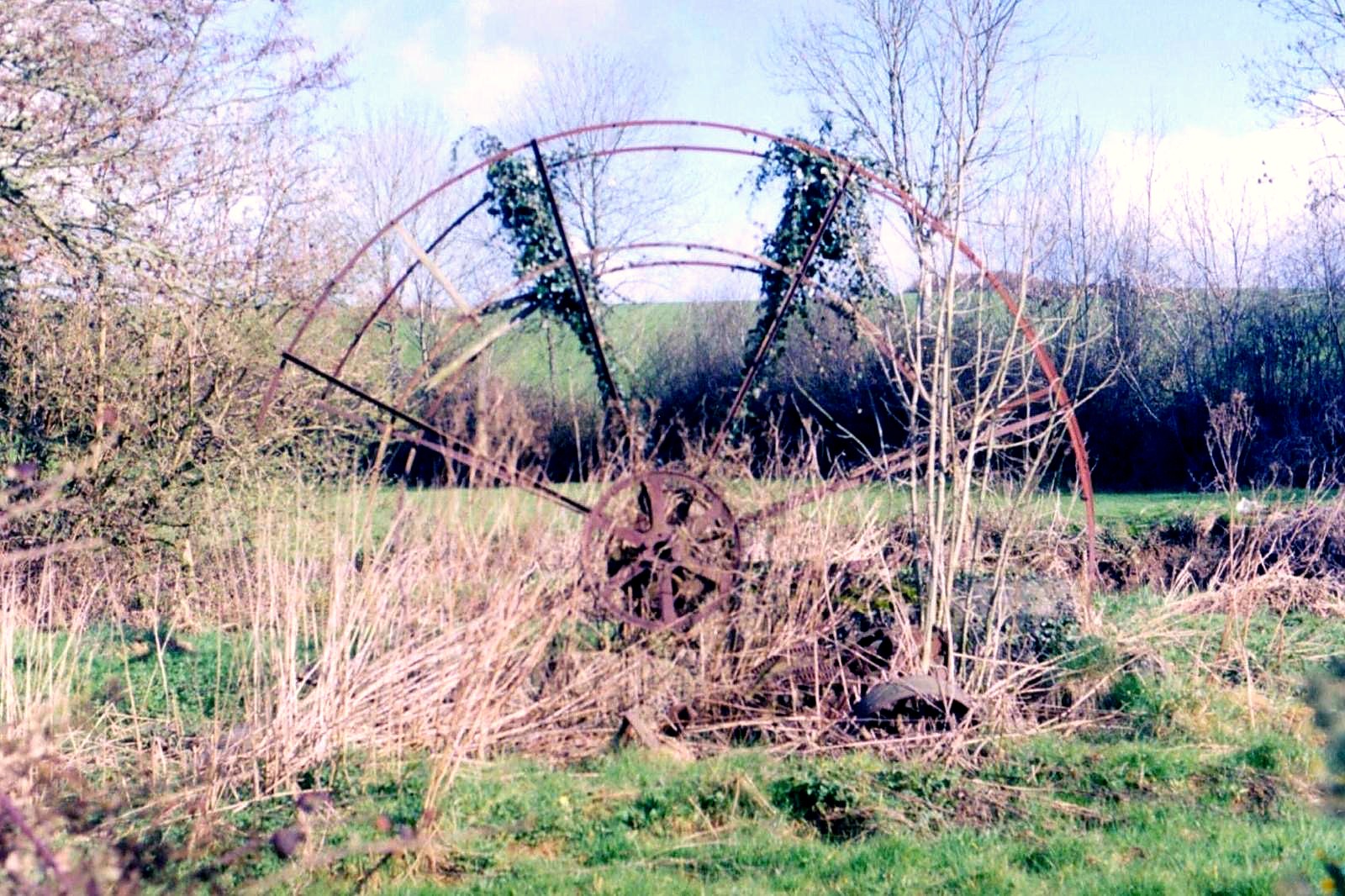
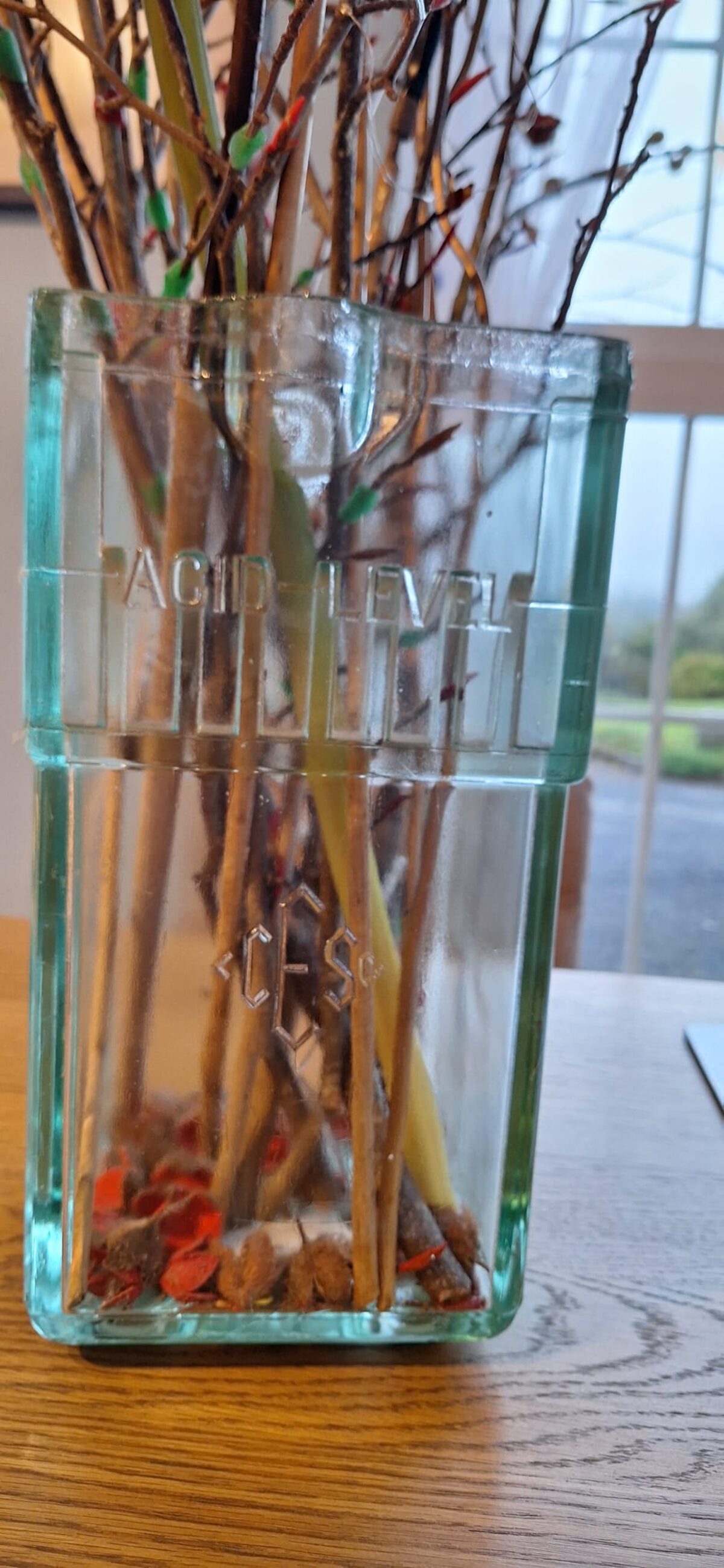
Long before the words “energy transition” entered common use, David's father hand-dug a headrace on the local river and built a fourteen-foot undershot waterwheel on this ground in the mid-1930s. It charged a bank of Chloride Electrical Storage Co 2.5-volt lead-acid cells — the English-made glass batteries of the era — and gave the family house its first electric light, decades before rural electrification reached this part of Tipperary.
The cells have had several lives since. From the 1940s onward David's grandmother used a number of them to preserve eggs in waterglass — sodium silicate, the standard pre-refrigeration method in rural Ireland, which kept the shells good for six months or more. She sold those eggs to help pay her grandchildren's school fees. Today the same cells are scattered across the extended family as vases and flower pots, their embossed “ACID-LEVEL” markings still legible through the water and branches. The waterwheel remains are still there too, on the same land where the solar PV arrays now generate. The 2018–2025 experiment is one chapter in a longer family story of curiosity, practical engineering, and refusing to throw useful things away.
About ten years ago David bought a 2.5 kVA generator with the intention of restarting the waterwheel project. The digger is still here. The engineering tools are still here. The plan is still open. The question hasn't changed in ninety years: what can we build, improve or rethink with the resources around us?
The commitment appeared in writing to an outside party for the first time in a routine email reply to ESB Networks. Reproduced verbatim:
“The export side of things is less relevant for the moment — I'd be much more keen on the increased MIC / night rate / 3 phase side of things for the moment. We have no microgeneration in place as yet, but are actively looking at this — Photovoltaic / Battery storage, wind or water turbine generator.”
“Internally, we have set a goal of trying to be 100% carbon neutral by 2025 — whether this is achievable or not is open to debate, but I'm going to have a good try anyway.”
The original ambition was carbon neutrality under a strict lifecycle definition. We didn't get there — but the transition changed how we heat, travel, generate and use electricity, and it changed the economics while it was changing those.
Figures describe different aspects of the project and are not a strict Scope 3 carbon-neutrality certification. The energy-reduction basis, grant received (€5,298 SEAI Non-Domestic Microgen on the Phase 2 solar expansion), and monthly meter data are documented on the SEAI 2026 submission page.
Each chapter is a detailed, first-hand account — including the costs, mistakes, trade-offs and lessons that don't normally make it into a brochure.
Three Teslas, a Mercedes EQS, a VW ID. Buzz. Seven years of real-world EV ownership, long journeys, charging at home on solar and the night rate, and the things nobody tells you until you've done it — range anxiety, the app faff, the tyre surprise, the Nokia 6110 question.
Read the EV story →Ten air-to-air units across the site. Oil and kerosene boilers out, wall and ceiling units in offices, workshops and the print room. They heat in winter, cool in summer, and run on the same solar electrons as everything else. Here is why we didn't go air-to-water, and what happened when we didn't.
Read the heat pump story →56 panels across two phases, 21.66 kWp installed, 30 kWh of storage, three Huawei inverters, one vendor-stack swap that forced the Sonnen battery over to the house, and one wind turbine that failed to live up to expectations. The core of the whole transition — the piece that makes every other piece pay back.
Read the solar story →The 2025 full year, measured on the Huawei FusionSolar monitoring platform attached to the business meter. These are meter readings, not models.
Site demand in 2025 was 28.13 MWh. Solar supplied 41.03% directly, with the remaining 58.97% imported from the grid. The honest frame: a substantial on-site generator, but not a net exporter across the year. Net grid import for 2025 was ~10.88 MWh, offset by €6,470 of Huawei-calculated revenue (self-consumption value + export income) and an €1,100 billing credit sitting with Electric Ireland at the end of summer.
2026 is tracking stronger: 16.53 MWh produced through October, €4,590 revenue year-to-date, and PV covering 46.07% of site demand. The Phase 2 array is now running its first full year at steady state.
After seven years, what the AgriData site actually produced wasn't abstract carbon reduction — it was a more useful operational reality. A modicum of energy independence on the days the sun shines, and across transport, heat and power, a more stable mix than we had in 2018.
Prices still rise. Energy drives the cost of everything else — materials, services, transport out of our control — and no amount of on-site generation changes that. But for the roughly 45% of our electricity we no longer buy from the grid, and for the heating oil and petrol/diesel we no longer burn at all, we are measurably insulated from the market price of those specific inputs.
One further effect, invisible until it starts. Our cushion is still exposed to the price of the grid electricity we do buy, and to the broader cost of goods and services — which all track energy inputs we don't produce ourselves. If Ireland did at national scale what we did at business scale — the argument on the vision page — those input prices would themselves become more stable, and our ~45% insulation would sit on top of a national baseline that moved less. The private cushion would compound on top of a national cushion. The biggest payoff of a transition is one that only shows up once it starts: the insulation compounds not just over time, but with every household and business that joins.
It isn't immunity. It's partial insulation. Over seven years the insulation compounds — and at national scale, it would compound further still.
The money answer, separately
If you want the ledger version rather than the story — what we spent, what it saves at today's prices, three defensible payback framings, and the SWOT — we published that as its own executive summary. Read the honest numbers →
One unexpected consequence of the seven-year experiment has been its influence beyond AgriData. Across the extended family, solar PV, battery storage and electric vehicles have become increasingly commonplace. Some decisions were influenced directly by what we were doing; others arose independently, driven by economics, environmental conviction, or simply discovering that the technology worked.
A 2015 Nissan Leaf, bought used as a three-year-old car with modest mileage, is now at 206,399 km on the clock and still providing dependable daily transport in the extended family. Around 110 km of real range if you don't go wild with the heating and the accelerator. Seven years of maintenance has been tyres and a few brake pads — nothing else. That car owes nothing to anyone. Other households have adopted newer electric vehicles alongside their own solar and storage installations. Two family members who teach sustainability are particularly committed to the transition for the sake of their children.
Nobody coordinated any of this. There was no family plan, no collective target, no obligation to participate. People made their own decisions, informed partly by seeing what worked for others.
Perhaps that is how meaningful change happens — not exclusively through ambitious national targets, but through practical examples that give others the confidence to make changes of their own.
The AgriData transition was possible because we had a profitable business that could fund it (96.2% self-funded from company reserves), land and roof space, and the ability to do the physical work the wood gasifier at the house requires. Many households and businesses do not have those advantages.
Tenants, tight-margin firms, and people without off-street parking are structurally locked into paying rising fossil-fuel costs because they cannot raise the capital to escape them. Short-term help (price caps, winter payments) eases the pressure for a season but leaves the underlying lock-in in place.
Not everyone can run their own 1745 pilot project. Designing a workable route for those who can't is the central policy question — and the subject of our vision page.
We started with one business, existing technologies and a willingness to experiment. Seven years later, the results raised a bigger question about energy independence, economic resilience and what could be achieved at national scale — applied to the systems that serve the whole country.
The seemingly impossible task is best tackled by first deciding to do it — deciding to start, not deciding to complete. The bits you can do get done. The bits you can't follow in time. What stops most ambitious projects is the paralysis of the whole; what starts them is the choice to begin.
“We choose to go to the Moon in this decade and do the other things,” said John F. Kennedy at Rice University in 1962, “not because they are easy, but because they are hard.” He was speaking about a lunar mission. The principle is portable. The impossibility of the task should not deter the attempt — it is, if anything, the reason to decide to make it.
This page is the public account. The SEAI 2026 submission page is the juror-facing record — verified against six Electric Ireland invoices for 2018 electricity, sixty-one diesel invoices from our accounting system, the Huawei FusionSolar meter, the full dated timeline from the 1930s waterwheel to the November 2026 gala, and the honest note on the wind turbine. Site visits welcome.
Read the SEAI 2026 submission →